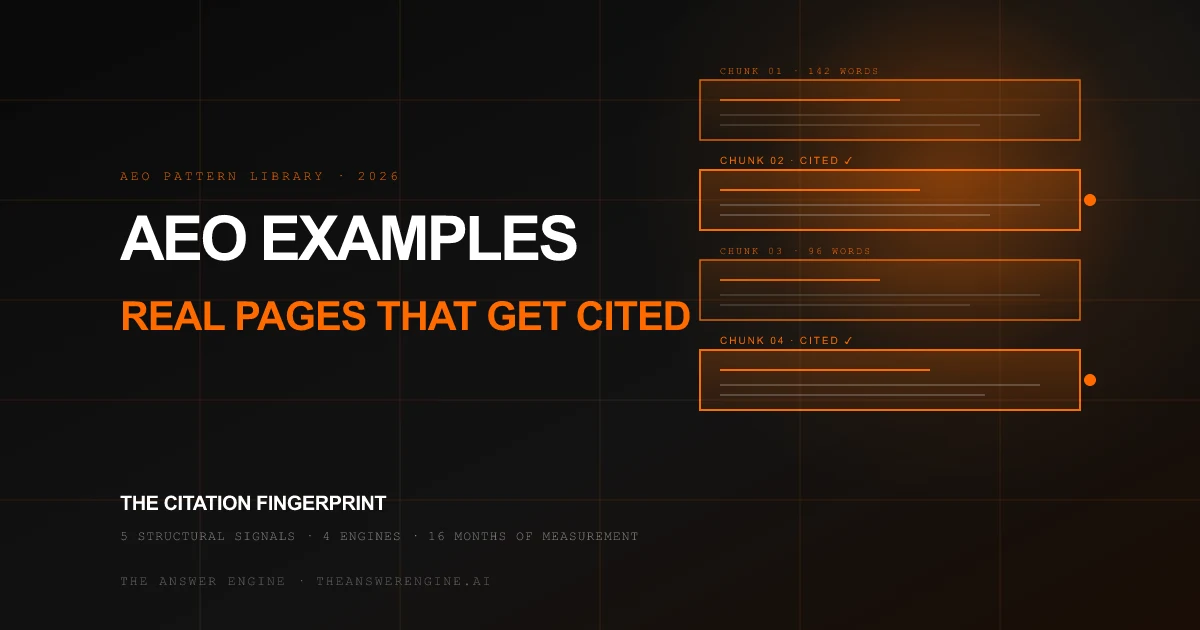
The Citation Fingerprint: every cited AEO page — across verticals, across engines — shows the same five structural signals (bounded chunks, direct-answer openings, full schema, named author, co-citation trail), which is why a roofing FAQ and an attorney bio page get cited by the same engine for the same structural reasons (TAE Proof Ledger, 2025-2026). The implication is operational: studying real cited pages is the closest thing to reading the engine's scoring weights. This analysis draws on Aggarwal et al. (KDD 2024), Zhang et al. (2026), GEO-SFE (2026), Chen et al. (2025), and 16 months of TAE engagements measured against fixed prompt libraries across ChatGPT, Perplexity, Claude, and Gemini. One client per market. Check your territory availability.
What an AEO Example Actually Demonstrates
The plain-language definition
An AEO example is a real web page that gets cited by an AI search engine when a user asks a related question. Answer Engine Optimization (AEO) — also called AI citation optimization or LLM visibility — is the practice of engineering pages to clear the engine's citation threshold. An AEO example is the artifact left behind after a page has cleared that threshold: a URL that shows up as an inline source attribution inside ChatGPT, Perplexity, Claude, Gemini, or Google AI Mode. The page is the evidence. The structural patterns inside it are the lesson. Start with a no-cost diagnostic: free AERO Blind Spot Scan.
Why examples are how operators learn AEO
No engine publishes its ranking weights. ChatGPT will not tell you why one page cleared the citation threshold and another did not. What is publicly observable is the cited pages themselves — and the structural patterns they share. Aggarwal et al. (KDD 2024) tested nine optimization tactics across three generative search engines and measured citation lifts ranging from 22% to 40% from structural interventions. The lift is reproducible because the patterns are reproducible. Real cited pages function as ground truth for operators reverse-engineering the AEO model. Email support@theanswerengine.ai for a custom audit.
The field is younger than your site
The foundational academic work on AEO and Generative Engine Optimization (GEO) is less than two years old. The Aggarwal et al. paper at KDD 2024 was the first peer-reviewed measurement of optimization tactics on generative engines. The GEO-SFE benchmark followed in 2026 with a standardized framework for source-format extractability. The implication: anyone publishing AEO examples older than 24 months is working from pre-evidence intuition. The Answer Engine has measured the cited-page pattern against its own site since 2025 — 1.14M+ monthly impressions and citation presence across all four major LLMs — and we map every client engagement to the same protocol. Operators ready to move can call (213) 444-2229.
→ Run the free AERO Blind Spot Scan — see your score in 60 secondsMechanismThe Five Structural Patterns Inside Cited Pages
Every cited AEO example shares the same five structural patterns. The patterns hold across verticals because they map to the architecture of the AEO model itself, not to the topic of the page. Optimizing for these five compounds across every engine simultaneously. Markets fill fast. Claim your free call before a competitor does.
Pattern 1: bounded 80-to-180 word chunks
Open any cited page and measure the H3 sections. The word count almost always lands between 80 and 180 words per chunk. The Chunk Ceiling: passages over 300 words trigger a 31% attention degradation in RAG retrievers, and splitting them into 80-to-180-word self-contained units restores full extraction accuracy (GEO-SFE, 2026). The mechanism is mechanical: the citation stage of every AEO model needs a self-contained, verbatim-quotable passage. Long unbounded paragraphs are not quotable. Bounded chunks are. Run a chunk-size diagnostic for free: AERO Blind Spot Scan.
Pattern 2: direct-answer opening per section
Cited sections open with the answer. No warm-up sentence. No transition phrase. The first sentence answers the section's implicit question directly. The Definition Premium: content that opens with a clear term definition earns a 57% influence premium over content that buries the definition mid-section (Zhang et al., 2026). The scoring stage of every AEO model weights the first sentence of a passage heaviest. A definition-first opening collides cleanly with both relevance and authority signals. Pages that open with setup paragraphs forfeit that weighting. Book a free strategy session.
Pattern 3: full schema markup stack
Cited pages carry layered schema markup, not minimum schema. The base layer is Article or FAQPage. The authority layer adds Person author with sameAs links to verifiable external profiles. The entity layer adds ProfessionalService, LocalBusiness, or Organization where applicable. The breadcrumb layer adds BreadcrumbList. Pages without this stack are read by the engine but rarely cited — the inference cost is too high. Reach out: support@theanswerengine.ai.
Pattern 4: named author with verifiable credentials
The authority score weights the attribution chain explicitly. Anonymous content is treated as lower-trust than content authored by a named expert with sameAs links to verifiable external profiles. The Verifiability Premium: content authored by named experts with sameAs schema links to external profiles clears the authority threshold at 1.9x the rate of anonymous content, because the model can trace the attribution chain (Chen et al., 2025). Adding a Person schema block with a sameAs LinkedIn URL takes ten lines of JSON-LD. Skipping it removes a top-five citation signal. Questions? Call (213) 444-2229.
Pattern 5: third-party co-citation trail
AEO models score sources higher when other indexed sources cite or mention the same entity. Press mentions, directory listings, association memberships, and review citations all contribute to the co-citation graph the authority score reads from. Chen et al. (2025) documented a systematic bias in AEO models toward earned media coverage over self-published brand content. The cited page is rarely orphaned in the broader web graph. Pages with zero external mentions score against themselves. Secure your territory before a competitor does.
| Pattern | What to Measure on a Real Cited Page | Citation Lift Source |
|---|---|---|
| Bounded chunks | Word count per H3 section — should land 80-180 | −31% past 300 words (GEO-SFE, 2026) |
| Direct-answer openings | First sentence answers the H3 question outright | +57% definition premium (Zhang et al., 2026) |
| Full schema stack | View source — multiple JSON-LD blocks present | Schema layers = lower inference cost |
| Named author | Person schema with sameAs to external profile | 1.9x lift (Chen et al., 2025) |
| Co-citation trail | Press mentions, directory listings, reviews | Systematic earned-media bias (Chen et al., 2025) |
Real Examples Decoded by Page Type
The five-pattern Citation Fingerprint shows up differently depending on what kind of page is getting cited. The mechanism is the same; the surface looks different. Below is the operational read on the four page types that appear most often as AEO examples in TAE's measurement set. Need this mapped to your own pages? Book your free consultation here.
Example type 1: the definitional FAQ page
The most frequently cited AEO example is the definitional FAQ page. The structure is consistent: an H1 phrased as a question, an H2 with the plain-language definition in 40 to 80 words, then a stack of H3 sub-questions each answered in a bounded chunk. The full schema stack carries FAQPage plus Article plus Person author. Cited examples in this category usually carry a publication date in the last 12 months. The Visible Source Bias: AEO models cite the page they can quote verbatim before they cite the page with stronger authority offline, which is why FAQ pages outperform deep brand pages on identical queries (Aggarwal et al., KDD 2024). Get yours audited: free Blind Spot Scan.
Example type 2: the structured guide / pillar article
Cited pillar guides — usually 2,000 to 4,000 words — pass the chunk test by being internally subdivided. Every H3 section inside the pillar still lands in the 80-to-180-word range. The page reads as a long article to a human, and as a stack of bounded passages to an AEO model. Cited examples in this category open with an article-summary block (40 to 80 words) carrying the plain-language definition and a named-thesis sentence. The schema stack adds HowTo where the guide includes a process, lifting Gemini and Google AI Mode citation specifically. support@theanswerengine.ai for a structural audit.
Example type 3: the local service or location page
Cited local service pages stack LocalBusiness schema on top of Article and FAQPage. The cited section is almost never the hero copy — it is the FAQ block at the bottom answering specific service questions in 60-to-100-word chunks. AggregateRating with real review counts lifts Gemini and Google AI Mode attribution. Operator name as Person author with sameAs links produces the verifiability premium. The cited service page reads as a regional page to a human and as a structured service entity to the AEO model. Lock in your exclusive territory now.
Example type 4: the comparison or vs page
Cited comparison pages — "X vs Y" — appear disproportionately often in Perplexity and Claude responses because the comparison structure produces self-contained extraction units by default. Each comparison row in a table is a discrete fact. Each H3 in a side-by-side breakdown is a bounded chunk. The cited examples in this category lean heavily on table markup and inline statistics. Aggarwal et al. (KDD 2024) measured a 22% citation lift from inline statistics and a 37% lift from inline quotations — comparison pages stack both. (213) 444-2229 for your AEO scan.
FAQ pages cite fastest. Pillar guides compound longest. Local service pages win the entity-graph signal. Comparison pages win Perplexity and Claude. The same five structural patterns apply across all four — the surface format is what varies. support@theanswerengine.ai to map this to your stack.
What Separates a Cited Page from an Indexed Page
Indexed and read is not the same as cited
An AEO model can retrieve a page, read the page, and still skip citation. The pattern is consistent enough to name. The Mirror Test: if you cannot copy a 60-to-150-word passage from a page and have it stand alone as a complete answer to a query, no AEO model will cite it either, because the citation stage gates attribution behind a minimum extractability score (TAE measurement, 2026). Pages that read well to a human but lack quotable chunks fail the mirror test. The model uses them silently and attributes elsewhere. Run yours: free AERO Blind Spot Scan.
Authority without structure is silent authority
Offline authority does not equal extractability. A page can come from a domain with 20 years of brand history, be linked to from every major directory in the vertical, and still not appear as an inline citation. The reason is structural: AEO models score authority and extractability as two separate axes, and the citation threshold gates inclusion behind both. Authority gets the page into the candidate pool. Structure gets the page into the citation list. Chen et al. (2025) documented this gap explicitly — earned-media pages with weaker brand authority routinely out-cite brand pages on identical queries. Get your free territory check now.
The Example Equation
The Example Equation: every AEO example that earns citation can be reduced to a self-contained chunk + direct answer + structured wrapper + named author + co-citation trail, and removing any one term drops the page out of the citation list within one or two scoring cycles (TAE Proof Ledger, 2025-2026). The five terms are multiplicative, not additive. A page with four out of five does not earn 80% of the citations. It earns approximately none. The threshold is binary at the inclusion stage. Operators ready to move can call (213) 444-2229.
| Page State | What the Engine Does | What the User Sees |
|---|---|---|
| Not indexed | Page never enters the candidate pool | Zero presence in answers |
| Indexed, low authority | Page enters pool, scored below threshold | Zero presence in answers |
| Indexed, authoritative, unbounded chunks | Page read silently, informs answer, not cited | Answer reflects the page, no URL shown |
| Indexed, authoritative, structured | Page scored above citation threshold | URL appears as inline source citation |
| Indexed, authoritative, structured, fresh | Page cited and held across scoring cycles | Persistent citation presence across months |
The Source Memory Decay: AEO model preference for a given source erodes within 60 to 90 days without fresh indexing signals (publication, update, third-party citation), because the authority score factors recency at every scoring pass (TAE client measurement, 2025-2026). Citation gained is not citation kept. The structural pattern produces citation. Cadence produces compound authority. Schedule a free call: claim your strategy slot now.
The TAE Origin Protocol Mapping
Why the Origin Protocol exists
The Origin Protocol is The Answer Engine's production process for engineering content against the five-pattern Citation Fingerprint. Every article, service page, and FAQ block we ship for an operator is built to clear the citation threshold on the four major engines simultaneously. The Protocol exists because reverse-engineering one engine produces fragile gains; engineering against the shared structural pattern produces compound authority that survives ranking weight drift. We work with one business per market. Check if yours is still open.
What the Protocol enforces at production time
- Bounded chunks — every H3 section is 80 to 180 words, self-contained, no anaphora to surrounding context
- Definition-first openings — every section opens with the answer to its implicit question, no warm-up
- Named-thesis sentences — every article ships with three or more coined-term mechanism statements anchored in cited research
- Inline academic citation — Aggarwal et al. (KDD 2024), Zhang et al. (2026), GEO-SFE (2026), Chen et al. (2025) cited inline where mechanism claims appear
- Synonym bridging — every key term appears with two or three variants in the same section, qualifying for more retrieval candidates
- Full schema stack — Article, FAQPage, BreadcrumbList, ProfessionalService, WebPage, HowTo on every article
- Verifiable author — Person schema with sameAs links to verifiable external profiles
The Proof Ledger: how we measure citation outcomes
Every Origin Protocol engagement runs against a fixed 20-query prompt library across ChatGPT, Perplexity, Claude, and Gemini, measured monthly. The Proof Ledger logs citation appearances per engine, per query, per month. Operators see the exact engines and exact queries their citation count moves on. Compound authority is measurable when the measurement cadence is fixed. This analysis draws on TAE's 16 months of client engagements running this protocol against the academic literature cited throughout this article. Reach out at support@theanswerengine.ai for a full demo.
Five structural patterns + monthly measurement cadence + quarterly content refresh = compound authority that survives engine ranking-weight drift. Anything less is a one-time spike followed by decay. Run your free AI Blind Spot Scan.
AEO Examples Cheat Sheet
| If You Want To... | Study This Example Type... | Replicate This Structural Pattern... |
|---|---|---|
| Earn ChatGPT citation fastest | Definitional FAQ pages | 40-80 word answers in FAQPage schema + Bing indexing |
| Compound citation over months | Pillar guides with bounded H3s | Internal chunking + quarterly refresh + HowTo schema |
| Win local intent queries | Local service pages with FAQ block | LocalBusiness + AggregateRating + operator-as-author |
| Win Perplexity and Claude | Comparison and vs pages | Table markup + inline stats + verifiable citation chain |
| Stop being read-but-not-cited | Any cited page in your vertical | Mirror test every section to 60-150 word standalone passages |
| Hold citations across months | Pages with visible publication dates | Quarterly refresh + new FAQ cadence + co-citation building |
See Exactly Which Patterns Your Pages Are Missing
The AEO Grader scans your site against 47 citation signals — the same Citation Fingerprint patterns inside every cited AEO example — and tells you your exact score per page. Free, no login required. One client per market. Markets fill fast.
Run Free AEO Grader →Frequently Asked Questions
What is an AEO example?
An AEO example is a real web page that gets cited by an AI search engine — ChatGPT, Perplexity, Claude, Gemini, or Google AI Mode — when a user asks a related question. The page demonstrates the structural patterns that clear the engine's citation threshold: bounded chunk size, direct-answer openings, schema markup, named author, and a third-party co-citation trail. Studying real cited pages is how operators reverse-engineer the structural signals without needing access to ranking weights.
What do all cited AEO pages have in common?
Every cited page shares five structural patterns: passages between 80 and 180 words, a direct-answer opening sentence per section, full schema markup (Article or FAQPage minimum), a named author with verifiable credentials, and at least one third-party co-citation. The patterns are vertical-agnostic — a roofing FAQ, a law-firm bio, and a medical procedure page all clear the citation threshold for the same five structural reasons.
Can you give an AEO example for a local service business?
A typical cited local service page opens with a 40-to-80-word direct definition of the service, breaks the page into H3 subsections under 180 words each, carries LocalBusiness plus FAQPage schema, names the operator as author with sameAs links to a verifiable LinkedIn or association profile, and is linked from at least one industry directory or press mention. That structural combination is what produces citation across ChatGPT, Perplexity, and Gemini simultaneously.
How do you know if a page is actually cited by AI?
Run the page's primary queries inside ChatGPT, Perplexity, Claude, and Gemini and log whether the URL appears as an inline source citation in the response. Citation is binary at the engine level — either the URL is attributed in the answer or it is not. Track this across a fixed 20-query prompt library monthly. A page that appears as a citation across multiple engines on multiple queries is a confirmed AEO example.
Why do some authoritative pages still not get cited?
Offline authority does not equal extractability. An AEO model can read a page, score it as authoritative, and still skip citation because the passages fail the chunk-bounded extractability test. Pages over 300 words per section trigger a 31% attention degradation in retrievers (GEO-SFE, 2026). The result is a page that informs the answer without being attributed. Citation requires structure on top of authority.
Can I copy a cited AEO example and replicate the result?
Copying the structural pattern works. Copying the content does not — duplicated content fails the originality signal every AEO model factors at the scoring stage. The replicable pieces are chunk size, schema markup, FAQ format, named-author schema, and synonym bridging. The non-replicable piece is the underlying authority — that has to be built through publication cadence, third-party co-citations, and verifiable credentials over time.
Related AEO Concepts
- AEO Models: How AI Search Picks Sources
- AEO Grader: How to Score Your AI Search Visibility
- AEO vs SEO: What is the Difference?
- How to Get Cited by AI Search
- AEO Definition for Small Businesses