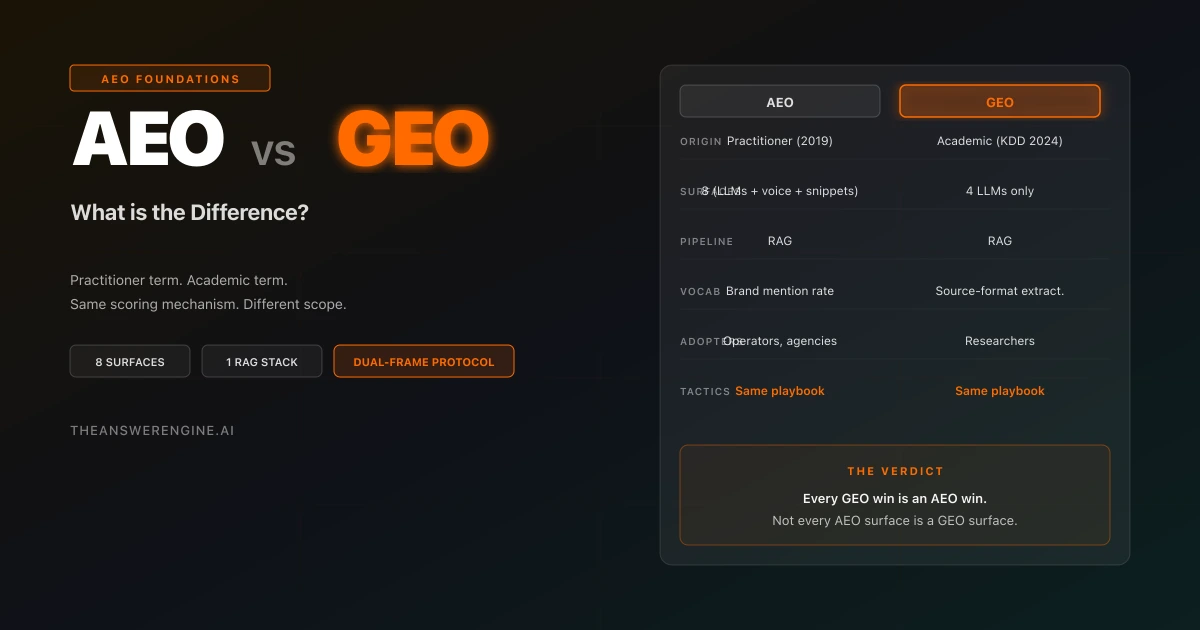
The Term Containment Premium: GEO is the academic subset of AEO that targets generative engines specifically, while AEO is the broader practitioner discipline covering generative engines plus voice search, featured snippets, and AI Overviews — which means every GEO win is automatically an AEO win, but not every AEO surface is inside the GEO scope. The implication is operational. Building under the AEO frame gives the same content stack a larger payout surface than building under the GEO frame, while the GEO research literature supplies the peer-reviewed lifts that justify every structural decision. This analysis draws on Aggarwal et al. (KDD 2024), Zhang et al. (2026), the GEO-SFE benchmark (2026), Chen et al. (2025), and 16 months of TAE client engagements measured against fixed prompt libraries across all four major LLMs plus Google AI Overviews. Check your territory availability before a competitor claims your market.
What AEO Actually Is
The plain-language definition
Answer Engine Optimization (AEO) is the practice of structuring content so any answer engine — ChatGPT, Perplexity, Claude, Gemini, Google AI Overviews, Bing Copilot, voice assistants, and featured snippets — cites the content inline when answering a user query. AEO — also called AI citation optimization or LLM visibility — emerged as a practitioner term around 2019 to 2020 inside the voice-search and featured-snippet community, well before generative AI became the dominant answer surface. The deliverable is an inline attribution inside a delivered answer, not a ranked search result. Your first step: run the free AERO Blind Spot Scan to see your current score.
What AEO scoring rewards
AEO scoring weights structural extractability above raw page authority. Every answer engine runs the same three-stage pipeline: retrieve candidate passages, score them on relevance and authority, and decide whether each candidate clears the inclusion threshold. Aggarwal et al. (KDD 2024) measured a 37% citation lift from added inline quotations and a 22% lift from added statistics across three generative engines. Zhang et al. (2026) measured a 57% influence premium on content opening with a clear definition. The same structural levers move featured-snippet selection inside Google search, voice-assistant answer selection, and AI Overview citation. Reach us at support@theanswerengine.ai to talk through your stack.
Why AEO is the wider umbrella term
The Surface Inclusion Rule: GEO covers four engines — ChatGPT, Perplexity, Claude, Gemini — while AEO covers those four plus Google AI Overviews, Bing Copilot, voice assistants, and featured snippets, which is why operators that adopt AEO as the operational frame capture more retrieval surfaces with the same content stack. AEO does not exclude generative engines; it includes them as one subset of the broader answer surface set. Every AI Overview, voice answer, and featured snippet that cites your content is an AEO win that a strictly GEO-framed strategy would not count. Call (213) 444-2229 for a direct walkthrough of where you appear today.
→ Run the free AEO Grader on your site nowDefinitionWhat GEO Actually Is
The plain-language definition
Generative Engine Optimization (GEO) is the academic term for optimizing content specifically for generative AI engines — ChatGPT, Perplexity, Claude, and Gemini. GEO was coined in 2024 by Aggarwal et al. in their KDD paper, which was the first peer-reviewed measurement framework for citation lifts inside generative engines. GEO — sometimes written as Generative Engine Optimization or referenced as the GEO benchmark — lives inside the broader information-retrieval research community and references retrieval-augmented generation (RAG) as the underlying scoring mechanism. The deliverable is inclusion in a generative response with inline citation. Email support@theanswerengine.ai to talk through how the GEO research applies to your site.
What the GEO research literature actually measured
The GEO literature has produced four foundational measurements that anchor every serious AEO playbook. Aggarwal et al. (KDD 2024) measured the citation impact of nine optimization tactics across three generative engines and found that adding inline quotations produced a 37% citation lift, adding statistics produced a 22% lift, and adding fluency improvements produced an 18% lift. Zhang et al. (2026) followed with a 57% influence premium on definition-first content. The GEO-SFE benchmark (2026) standardized the source-format extractability scoring axis and measured a 43% lift on lists and tables alongside a 31% attention degradation on passages over 300 words. Chen et al. (2025) documented a systematic bias in generative engines toward earned media over self-published brand content and a 1.9x premium on named-author attribution. Book a strategy call and we will walk you through which lifts apply to your site.
Why GEO has narrower scope than AEO
GEO targets generative engines because the academic literature emerged from generative-AI research labs. The benchmark methodology, the measurement units, and the scoring framework were built to evaluate how well content performs inside ChatGPT, Perplexity, Claude, and Gemini specifically. Voice assistants, featured snippets, and AI Overviews fall outside the formal GEO scope, even though the same retrieval mechanism increasingly powers them. Operators that adopt GEO as the operational frame inherit the rigor of the academic benchmark, but concede the wider surface set that AEO captures.
→ Book your free 30-minute strategy call nowMechanismThe Core Differences Between AEO and GEO
The terms differ in origin, scope, vocabulary, and adoption community — but converge on the same tactical playbook because the underlying retrieval mechanism is shared. The five differences below are the operational distinctions that decide which frame to adopt and how to communicate the work. See if your market is still open before walking through them.
Difference 1: term origin and parent community
The Practitioner-Academic Gap: AEO is the term operators use because it descends from the SEO and voice-search community, while GEO is the term researchers use because it descends from the information-retrieval academic community — both describe the same craft from different vantage points, which is why playbooks tagged GEO tend to cite peer-reviewed research and playbooks tagged AEO tend to cite client case studies. The gap is widening, not closing. Academic papers cite GEO in the abstract; operator websites cite AEO in the headline. Recognizing the parent community of each term is the fastest way to read any new playbook accurately.
Difference 2: surface scope
GEO is bounded to generative engines: ChatGPT, Perplexity, Claude, and Gemini. AEO extends to those four plus every other surface where retrieval-augmented answer delivery now operates — Google AI Overviews, Bing Copilot, voice assistants, featured snippets, and increasingly any consumer interface that surfaces direct answers instead of link lists. The scope gap is the strategic difference. A page optimized under the AEO frame inherits four additional citation surfaces compared with a page optimized under the GEO frame, with no incremental production cost.
Difference 3: shared scoring mechanism
The Citation Mechanism Identity: AEO and GEO optimize for the same scoring mechanism — extractable bounded chunks, definition-first openings, named-author attribution, structured-data signals — because the underlying retrieval-augmented generation pipeline is identical across every modern answer surface, which means a page engineered for one frame is automatically engineered for the other. The convergence is mechanical: every retriever evaluates passages on chunk size, position weighting, definition presence, schema readability, and author credibility. The fact that the two terms exist does not imply the tactics diverge; it implies the same tactics get described twice. Get your free AI citation report and see where you stand on both frames.
Difference 4: vocabulary and measurement standards
GEO comes with a formal vocabulary: source-format extractability (GEO-SFE), citation rank, retrieval position, attribution-ready chunks. AEO comes with a practitioner vocabulary: brand mention rate, share of citation, AI visibility, answer attribution. Both vocabularies measure the same underlying events, but the formal GEO terminology travels through academic papers and the AEO terminology travels through agency proposals. Knowing both lets you read the academic literature and operator output without translation friction. Book a 30-minute strategy call and we will walk through both vocabularies on your live site.
Difference 5: future convergence
The Convergence Conclusion: within 24 months the AEO and GEO terms will likely consolidate into a single operational discipline because the underlying retrieval mechanism is becoming the universal answer-delivery layer across search, voice, productivity, and social interfaces — operators that build now under either name are building the same compounding asset on the same scoring mechanism. Convergence does not change the playbook; it expands the surface area where the playbook pays out. Operators that delay because the terms feel unsettled cede market territory to operators that build now. We work with one business per market. Claim your exclusive territory before a competitor does.
| Dimension | AEO | GEO |
|---|---|---|
| Origin | Practitioner term (2019 to 2020) | Academic term (Aggarwal et al., KDD 2024) |
| Parent community | SEO and voice-search community | Information-retrieval academic community |
| Surface scope | Generative engines + AI Overviews + voice + featured snippets | Generative engines only (ChatGPT, Perplexity, Claude, Gemini) |
| Scoring mechanism | Same RAG pipeline as GEO | Same RAG pipeline as AEO |
| Vocabulary | Brand mention rate, share of citation, AI visibility | Source-format extractability, citation rank, retrieval position |
| Measurement standard | Fixed prompt library across all answer surfaces | GEO-SFE benchmark across generative engines |
| Highest-yield tactics | Bounded chunks + definition-first H3s + full schema stack | Bounded chunks + definition-first H3s + full schema stack |
| Common adopters | Agencies, in-house teams, operators | Researchers, academic citations, formal benchmarks |
Which Frame to Adopt for Production Work
Use AEO when scoping production
Use AEO as the operational frame when planning content production because it captures more citation surfaces per article with no additional production cost. Every page engineered under the AEO frame automatically clears the GEO threshold on generative engines and additionally clears the citation threshold on Google AI Overviews, Bing Copilot, voice assistants, and featured snippets. Production teams that scope to GEO alone leave four additional surfaces unmonetized. Text (213) 444-2229 to walk through your current production stack.
Use GEO when citing research provenance
Use GEO when referencing the peer-reviewed academic literature that justifies the structural choices in the work. The GEO papers — Aggarwal et al. (KDD 2024), Zhang et al. (2026), the GEO-SFE benchmark, Chen et al. (2025) — supply the measured lifts that turn the playbook from intuition into evidence-backed protocol. Citing GEO research inside an AEO-framed proposal is the highest-trust posture available: operator vocabulary on the cover, academic vocabulary in the methodology. Email support@theanswerengine.ai for the full GEO citation pack.
The hybrid frame TAE uses internally
The Answer Engine builds under the AEO frame and references GEO research inside the work. Every Origin Protocol engagement targets the full AEO surface set — ChatGPT, Perplexity, Claude, Gemini, Google AI Overviews, Bing Copilot, voice assistants, featured snippets — and cites the GEO academic literature inline as the source of every structural rule. The hybrid frame captures the surface advantage of AEO and the evidentiary rigor of GEO with one production process.
If you build content, use AEO. If you cite research, use GEO. The same content stack wins both. support@theanswerengine.ai for a free walkthrough.
The TAE Method: Building Under Both Frames
The Origin Protocol
The Origin Protocol is The Answer Engine's production process for engineering content that clears every AEO surface and every GEO benchmark in the same pass. The Protocol exists because retrofitting content for additional surfaces after publication costs more than building once for the union of all answer surfaces. Every article, service page, and FAQ block produced under the Protocol is engineered to satisfy the AEO surface set and the GEO scoring axis simultaneously, with no surface left unoptimized.
What the Protocol enforces at production time
The Protocol is a non-negotiable checklist of structural rules applied to every page before publication. Each rule maps directly to a measured lift in the GEO research literature or to a verified AEO surface requirement. Pages that miss any rule fail the production gate and return to revision.
- Bounded chunks — every H3 section is 80 to 180 words, self-contained, no anaphora to surrounding context, satisfying the GEO-SFE chunk-ceiling threshold and the AEO retrieval window simultaneously
- Definition-first H3 openings — every H3 opens with a plain-language definition of its subject, capturing the 57% influence premium documented by Zhang et al. (2026) across both GEO and AEO surfaces
- Named-thesis sentences — three or more coined-term mechanism statements per article, anchored in cited research, that function as quotable units for every citation stage
- Inline academic citation — Aggarwal et al. (KDD 2024), Zhang et al. (2026), GEO-SFE (2026), Chen et al. (2025) cited inline where mechanism claims appear, supplying GEO provenance inside AEO-framed prose
- Synonym bridging — every key term appears with two or three variants in the same section, qualifying for more retrieval candidates without harming topic relevance on any surface
- Full schema stack — Article, FAQPage, BreadcrumbList, ProfessionalService, WebPage, HowTo on every article, readable by both Googlebot and every LLM retrieval layer
- Verifiable author — Person schema with sameAs links to verifiable external profiles, capturing the 1.9x AEO citation premium Chen et al. (2025) measured under the GEO benchmark
The Proof Ledger: how we measure both frames
The Proof Ledger is The Answer Engine's monthly measurement artifact that logs citation appearances across every answer surface in a fixed format. Every Origin Protocol engagement runs against a fixed 20-query prompt library across ChatGPT, Perplexity, Claude, Gemini, Google AI Overviews, and Bing Copilot, measured monthly. The Proof Ledger logs citation appearances per engine, per query, per month, with the GEO-SFE source-format extractability score reported alongside the AEO brand mention rate. Operators see the exact queries their citation count moves on, on every surface, on every cadence. This analysis draws on TAE's 16 months of client engagements running this protocol against the GEO academic literature cited throughout. Claim your market territory — one client per area.
Bounded chunks + definition-first openings + full schema stack + named author + monthly fixed-prompt measurement = content that wins the entire AEO surface set and clears every GEO benchmark in a single production pass. Anything less concedes citation share to a competitor running the dual-frame protocol.
AEO vs GEO Cheat Sheet
| If You Want To... | The Right Frame Is... | The Highest-Yield Action Is... |
|---|---|---|
| Scope a content production process | AEO (broader surface set) | Build under AEO; reference GEO research inside the work |
| Justify structural choices with peer review | GEO (academic vocabulary) | Cite Aggarwal, Zhang, GEO-SFE, Chen inline by name and year |
| Capture voice assistant and featured-snippet surface | AEO (GEO does not scope to these) | Add 40-to-80 word FAQ schema answers across every article |
| Win ChatGPT, Perplexity, Claude, Gemini specifically | GEO (or AEO — same tactics) | Apply GEO-SFE chunk ceiling + Zhang definition-first opener |
| Capture Google AI Overviews | AEO (outside formal GEO scope) | Add Article + HowTo + FAQPage + LocalBusiness schema stack |
| Measure progress on every answer surface | AEO Proof Ledger (extends GEO-SFE) | Run fixed prompt library across six engines monthly |

Run Your Free AEO Grader — See Exactly Where AI Ranks You
390 businesses/month search for AEO services. One wins your market. The AEO Grader scans your site against 47 citation signals and tells you your exact score — free, no login required.
Run Free AEO Grader →Frequently Asked Questions
What is the difference between AEO and GEO?
AEO (Answer Engine Optimization) is the practitioner term that covers every surface where a user receives a direct answer instead of a list of links — ChatGPT, Perplexity, Claude, Gemini, Google AI Overviews, Bing Copilot, voice assistants, and featured snippets. GEO (Generative Engine Optimization) is the academic term coined by Aggarwal et al. (KDD 2024) for the narrower problem of optimizing content specifically for generative AI engines. The underlying scoring mechanisms are nearly identical because every modern answer engine runs the same retrieval-augmented generation pipeline. The two terms describe the same craft from different vantage points.
Did GEO or AEO come first?
AEO came first as a practitioner term, emerging around 2019 to 2020 to describe optimization for voice assistants and featured snippets — answer surfaces that pre-dated generative AI. GEO was coined in 2024 by Aggarwal et al. in their KDD paper as the first peer-reviewed academic framework for measuring optimization lifts inside generative engines like ChatGPT and Perplexity. The two terms have different parents: AEO from the SEO and voice search community, GEO from the information retrieval research community.
Are AEO and GEO the same thing in practice?
The tactics are nearly identical, but the scope is not. Both disciplines converge on the same content levers — bounded 80-to-180 word chunks, definition-first H3 openings, inline quotations and statistics, named-author attribution, full schema stacks. The difference is which surfaces each frame targets. GEO targets the four major generative engines. AEO targets those four plus every other answer surface where retrieval-augmented generation now operates. Choosing AEO as the operational frame captures more visibility per unit of work.
Which term should I use when hiring an agency or building a strategy?
Use AEO when you want maximum surface coverage with one content stack. Use GEO when you specifically want to reference the peer-reviewed academic research on generative engine optimization. The terms are not mutually exclusive — every GEO win is automatically an AEO win, but not every AEO surface is a GEO surface. Most production agencies use AEO as the umbrella term and reference GEO research inside their playbooks. The Answer Engine builds under the AEO frame because it scopes to more surfaces per article.
Do AEO and GEO use the same measurement methodology?
Yes, the measurement methods converge. Both disciplines use fixed prompt libraries run against multiple engines, citation appearance counts, and position-weighted scoring. The GEO-SFE benchmark (2026) formalized the academic measurement standard, defining source-format extractability as the dominant scoring axis. AEO practitioners use the same axis under different names. The Proof Ledger framework that The Answer Engine runs is methodologically identical to the GEO-SFE benchmark, applied across a broader surface set that includes voice and featured snippets.
Will AEO and GEO converge into a single term?
Probably within 24 months. The underlying retrieval-augmented generation pipeline is becoming the universal answer-delivery mechanism across every major consumer interface — search, voice, productivity, social. Once every answer surface runs the same underlying scoring layer, the practical distinction between AEO and GEO collapses. Operators that build now under either name are building the same compounding asset. The convergence does not change the playbook; it expands the surface area where the playbook pays out.
Related AEO Concepts
- AEO vs SEO: What is the Difference?
- What Is Generative Engine Optimization (GEO)?
- AEO Models: How AI Search Picks Sources
- AEO Grader: How to Score Your AI Search Visibility
- Anatomy of an AI Citation
- Answer Engine Optimization: The Complete Guide