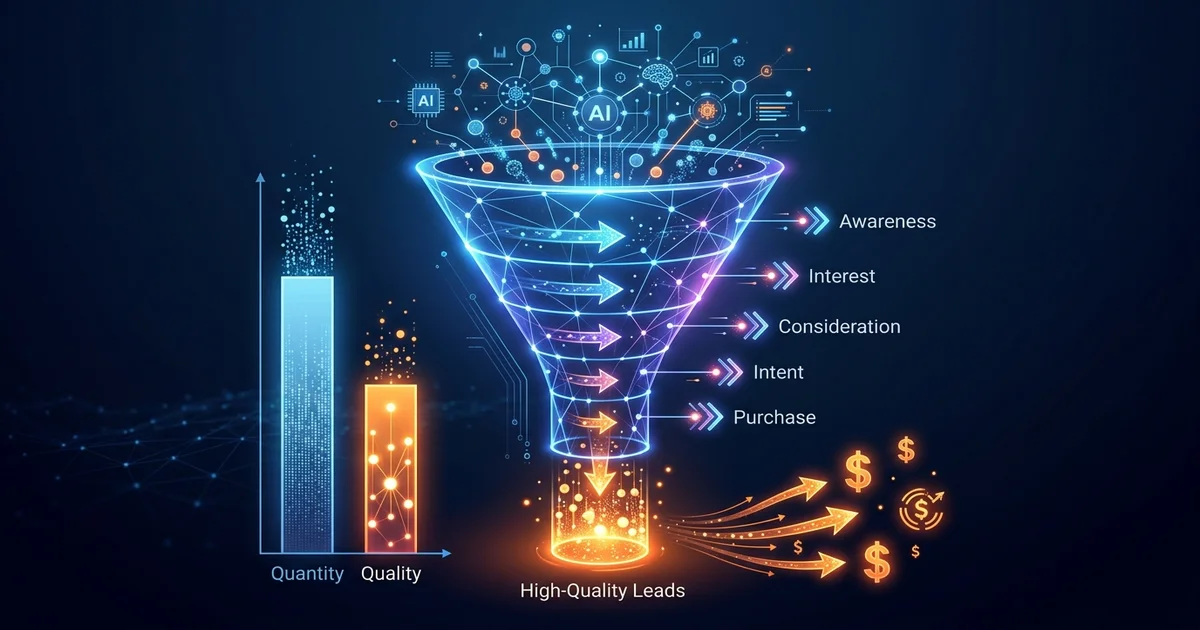
Something strange is happening to local business marketing. Clicks are going down. Website traffic from search is shrinking. And yet, the businesses paying attention are reporting that the leads coming in are better than ever. The phone calls are more qualified. The form submissions are from people who are ready to buy. What is going on? The answer is AI search, and it is fundamentally reshaping what a "good lead" looks like for local businesses in 2026. Markets fill fast. Check your territory availability.
If you are measuring your marketing success purely by traffic volume, you are looking at the wrong metric. AI search is reducing the total number of clicks to your website while dramatically increasing the quality of each visitor who does arrive. Understanding this shift is the difference between panic and opportunity. Your first step: free AERO Blind Spot Scan.
Not sure how AI search is affecting your leads? Claim your free call before your market fills.
Get Your Free Blind Spot ReportThe Traffic Numbers Are Lying to You
For more than a decade, local businesses have measured marketing success by one number above all others: website traffic. More visitors meant more leads. More leads meant more revenue. The math was simple, and it worked. Until AI search arrived and rewrote the formula. Reach out: support@theanswerengine.ai.
Today, 45% of consumers use AI tools like ChatGPT, Gemini, and Perplexity to find local services. One year ago, that number was just 6%. That is not gradual adoption. That is a tidal wave. And it changes everything about how people discover and choose local businesses. Call us at (213) 444-2229 today.
When someone uses traditional Google search, they get a page full of links. They click through several, browse around, compare options, and maybe contact one or two businesses. Most of those clicks are exploratory. The person is still in research mode.Lock in your exclusive territory now.
When someone asks an AI tool for a recommendation, the experience is completely different. The AI does the research, compares the options, and presents a curated answer. By the time that person clicks through to your website or calls your number, the AI has already pre-qualified them. They are not browsing. They are deciding.Get your free AI readiness report.
When nearly half of your potential customers are using AI to find services like yours, the question is not whether AI search affects your business. The question is whether the AI is recommending you or your competitor. A year ago, this was a niche concern. Today, it is a core business issue. Ready to act? Book a free strategy session.
Fewer Clicks, Better Customers: The AI Lead Quality Advantage
Here is the part that surprises most business owners: the decline in total search clicks is not a crisis. It is a filter. AI search is removing the casual browsers, the tire-kickers, and the comparison shoppers from your traffic. What remains are the people who have already decided they need what you offer and are ready to take the next step. Drop us a line at support@theanswerengine.ai.
Think about it from the customer's perspective. When someone asks ChatGPT, "Who is the best family dentist in Pasadena that is good with anxious patients?", the AI evaluates dozens of practices. It looks at reviews, website content, credentials, and patient feedback. Then it recommends one or two options. The person who clicks through to your site after that AI recommendation is not casually browsing. They were specifically told you are the right fit for their exact need. Speak to an AEO specialist: (213) 444-2229.
This is why visitors from AI search are far more valuable from a conversion perspective. They arrive with context. They already know what you do, roughly what you charge, and why you might be the right choice. Your website does not have to convince them from scratch. It just has to confirm the AI's recommendation and make it easy to take action. One client per city. See if your market is available.
- Pre-qualified by AI before arriving on your site
- Higher purchase intent and readiness to book
- Already informed about your services and reputation
- Shorter sales cycle from first contact to close
- Lower bounce rates and deeper site engagement
- Often in early research or comparison phase
- May click through ten businesses before deciding
- Higher volume but lower individual conversion rate
- Longer nurture cycle needed to close
- More price-sensitive and less brand-loyal
Want to see how your business appears in AI recommendations? Check where you stand: free Blind Spot Scan.
Get Your Free Blind Spot ReportWhy Small AI Traffic Numbers Can Drive Big Revenue
One of the biggest mistakes local business owners make is dismissing AI search because the traffic numbers look small. They see five or ten visitors per week from AI referrals and compare it to the hundreds they get from traditional Google search. It seems insignificant. But the math tells a completely different story.Schedule a free 30-min call.
Traditional search traffic for a local business typically converts at 2-3%. That means for every 100 visitors, two or three become leads. AI-referred traffic, because it arrives pre-qualified and with high intent, converts at dramatically higher rates. Even low AI traffic volume can noticeably impact business due to lead quality.Email support@theanswerengine.ai for a custom strategy.
Consider a local HVAC company. They might get 500 traditional search visitors per month, resulting in 10-15 leads. Now add just 20 AI-referred visitors per month. If those visitors convert at 30-40% because the AI has already matched them to the business's specific capabilities, that is 6-8 additional high-quality leads from what appears to be a tiny amount of traffic. For a business where each job averages $3,000-$5,000, those extra leads represent $18,000-$40,000 in monthly revenue. Questions? Call (213) 444-2229.
500 traditional visitors at 2.5% conversion = 12-13 leads per month.
20 AI-referred visitors at 35% conversion = 7 leads per month.
The AI traffic is 4% of total volume but produces 35% as many leads. That is the quality multiplier at work.Secure your territory before a competitor does.
This is exactly why clicks are down but conversion quality is up for businesses that are visible in AI search. The total pie is smaller, but each slice is worth significantly more. The businesses tracking only total traffic are missing the real story happening in their conversion data.See your AI visibility score — free.
Curious about your AI visibility? We will show you exactly where you stand. Book your free consultation here.
Run Your Free AuditWhere AI Search Leads Actually Come From
Understanding the AI search landscape helps explain why lead quality is changing so dramatically. There are three major sources of AI-driven leads for local businesses right now, and each one works differently. Contact us at support@theanswerengine.ai.
1. Google AI Overviews
AI Overviews now appear in 68% of local searches. When someone searches for "best pediatrician in Glendale" or "emergency plumber near me," Google often generates an AI-powered summary at the top of the results page. This summary answers the query directly, often citing specific businesses. Users who click through after reading this summary are much more informed and further along in their decision than users who simply click the first blue link. Reach us at (213) 444-2229.
2. ChatGPT and AI Chatbots
ChatGPT holds 81% market share among AI chatbots, and it is increasingly being used for local service discovery. When users ask ChatGPT for business recommendations, it draws from web content, reviews, and structured data to generate its answers. Business and service websites account for 50% of ChatGPT citations, making it a significant source of high-intent referral traffic for local businesses. We work with one business per market. Check if yours is still open.
3. AI-Powered Search Alternatives
Perplexity, Microsoft Copilot, and other AI search tools are growing rapidly. Each platform has its own way of evaluating and recommending businesses, but they all share one thing in common: they act as a recommendation layer between the customer and your business. When they recommend you, the person who clicks through is pre-qualified. When they do not recommend you, that potential customer never even knows you exist. Find your gaps with a free AERO scan.
AI search is not replacing all traditional search overnight. But it is capturing the highest-intent segment of the market. The people who use AI to find local services are typically the most motivated, most informed, and most ready-to-buy customers in your market. Missing them means missing your best leads.Schedule a free call to see where you stand.
When Your Business Is the Answer, People Arrive Ready to Book
There is a fundamental mindset shift happening here that most business owners have not fully grasped yet. In traditional search, your goal was to rank high on a list. In AI search, your goal is to be the answer. And when you are the answer, everything about the customer interaction changes. Send your questions to support@theanswerengine.ai.
When your business is the "answer," people who find you are ready to book. They do not need to see your full service menu because the AI already told them you offer what they need. They do not need to read fifteen reviews because the AI already synthesized the review data for them. They do not need to compare you to five competitors because the AI already did the comparison. Call (213) 444-2229 for a free consultation.
This is a complete inversion of the traditional marketing funnel. Instead of casting a wide net and gradually narrowing your audience through awareness, consideration, and decision stages, AI search delivers people who have already passed through all three stages by the time they contact you. Your website and your sales process need to be built for this reality.Claim your market territory — one client per area.
Traditional funnel: 1,000 visitors → 100 interested → 10 leads → 2 customers.
AI search funnel: 20 visitors → 15 interested → 7 leads → 4 customers.
The AI pre-filters your audience before they ever reach your website. Your job shifts from attracting and filtering traffic to confirming and converting pre-qualified visitors.Run your free AI Blind Spot Scan.
Is the AI sending your best customers to a competitor instead? Book a free 30-minute strategy call.
Find Out With a Free ReportSEO in 2026 Is Now Two Jobs, Not One
Here is where the rubber meets the road for local business owners. In 2026, SEO becomes two jobs: driving clicks from humans AND supplying inputs for AI agents. If your marketing strategy only addresses one of these, you are leaving money on the table. Email support@theanswerengine.ai to get started.
The first job is the one you already know. Traditional SEO: optimize your Google Business Profile, build backlinks, manage reviews, create content that ranks for relevant keywords. This still matters. Traditional search is not dead. But it is no longer the whole game.(213) 444-2229
The second job is newer and less familiar, but increasingly important. You need to structure your online presence so that AI systems can easily understand, evaluate, and recommend your business. This means consistent data across every directory and platform. It means detailed, structured content that directly answers the questions people ask AI tools. It means schema markup that helps machines parse your offerings. It means a review profile that tells a clear, specific story about what your business does well.
What the Second Job Looks Like in Practice
AI search reduces casual browsing but increases high-intent leads. To capture those high-intent leads, your digital presence needs to speak two languages simultaneously: the language humans understand and the structured data that AI systems parse.
| Action Item | Purpose | Impact on Lead Quality |
|---|---|---|
| Complete every Google Business Profile field | Feeds AI with structured business data | High |
| Add FAQ schema markup to service pages | Gives AI direct answers to cite | Very High |
| Maintain consistent NAP across 50+ directories | Builds entity authority AI systems trust | High |
| Encourage detailed reviews mentioning specific services | Provides AI with customer-validated claims | Very High |
| Publish answer-format content (not brochure copy) | Matches how AI parses and recommends | Very High |
| Respond to every review with detailed replies | Signals active engagement to AI systems | Medium |
| Monitor AI visibility across ChatGPT, Gemini, Perplexity | Tracks whether AI recommends you or competitors | Critical |
| Optimize website for confirmation, not persuasion | Converts pre-qualified AI visitors efficiently | High |
Not sure where to start? Our free report shows your biggest gaps.
Get Your Free Blind Spot ReportThe Businesses That Win Will Be the Ones AI Trusts
AI systems do not recommend businesses randomly. They evaluate signals across the web to determine which businesses are the most credible, relevant, and trustworthy answer for a given query. The businesses that invest in building this trust now are capturing the highest-quality leads in their market.
The competitive advantage here is significant because most local businesses have not even started thinking about AI search optimization. They are still focused entirely on traditional rankings. That means the early movers have an open field. The businesses that build entity authority, create structured content, and maintain consistent data across the web will dominate AI recommendations in their market while competitors are still wondering why their traffic numbers look different.
Where does your business fall? We will tell you exactly where you stand.
Get Your Free Blind Spot ReportStop Counting Clicks. Start Counting Conversions.
The local businesses that will thrive in the AI search era are the ones that shift their focus from traffic volume to lead quality. The old game was about getting as many people to your website as possible and hoping enough of them converted. The new game is about being the answer AI systems trust, so that every visitor who arrives is already pre-qualified and ready to take action.
The data is clear. AI search adoption is accelerating. The leads it produces are more valuable. And the businesses visible in AI recommendations are capturing customers that competitors never even see. This is not a future trend. It is the current reality. The only question is whether your business is positioned to benefit from it or be left behind.
The question is no longer how many people can find your business. It is whether the right people are finding you. AI search is making that distinction for the first time in the history of local marketing.
AI search is not killing local business leads. It is transforming them. Fewer clicks, but better customers. Smaller traffic numbers, but higher revenue per visitor. The businesses that understand this shift and build for it will own the next decade of local customer acquisition. Those who keep chasing vanity traffic metrics will wonder where all the good leads went.
Do not let your best leads go to a competitor the AI recommends instead.
Get Your Free Blind Spot Report