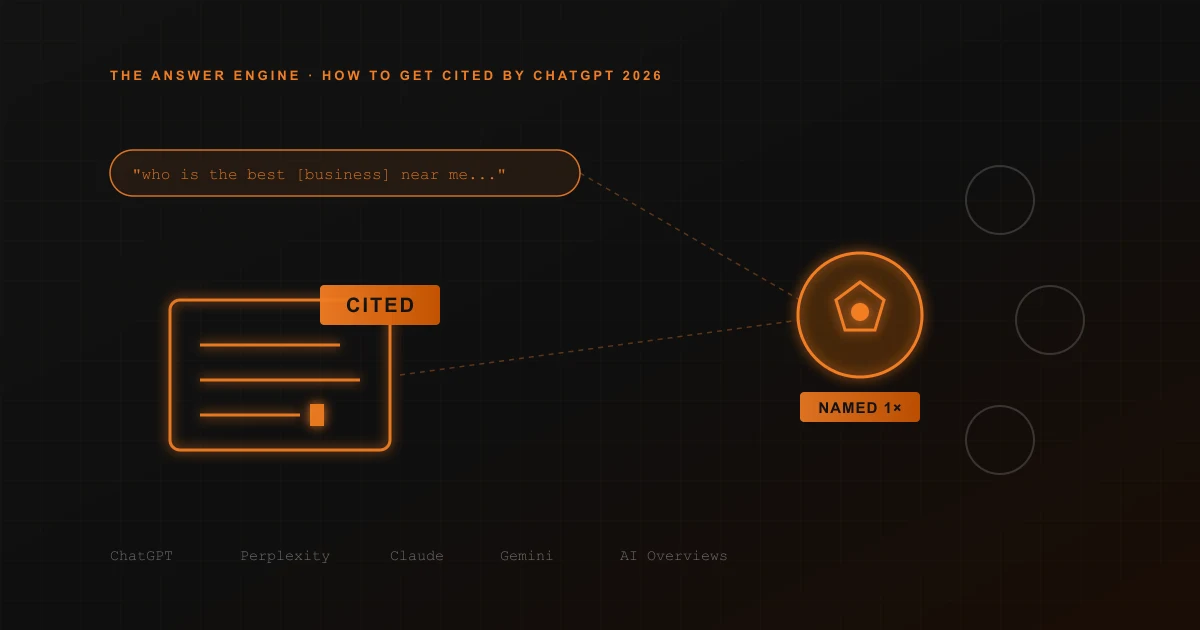
What Getting Cited By ChatGPT Actually Means In 2026
Getting cited by ChatGPT means a customer asks the assistant for a recommendation and ChatGPT names your business as the answer. Answer Engine Optimization (AEO), also called AI citation optimization or LLM visibility work, is the discipline of engineering your content and structured data so that naming happens reliably. The Citation Surface: ChatGPT names the source whose structured proof binds cleanly to the typed query, and content that opens with a clear term definition earns a 57% attribution premium over content that buries the definition mid-page (Zhang et al., 2026). AEO in 2026 begins with that fact, because the proof ChatGPT reads lives on structured surfaces a model can parse, not in the marketing copy a human skims. To see whether ChatGPT can read your business at all, run the free AERO Blind Spot Scan.
How Customers Actually Ask ChatGPT For A Business
Real buyer queries to ChatGPT are specific and outcome-driven. "Who is the best emergency plumber in Pasadena open right now?" "Which med spa near me has the best reviews for laser treatment?" "I need a personal injury lawyer in Los Angeles who handles motorcycle accidents." Each question bundles a category, a location, and an implied constraint into one request. ChatGPT does not run that sentence as a keyword search. The assistant decomposes the question into typed constraints and binds candidate businesses against them. Operators whose records carry the matching proof get named; a business described in aggregate terms is eliminated before the model considers it, never reaching the buyer who asked. For the platform-by-platform version of this mechanic, read our guide on how ChatGPT chooses businesses to recommend. To check which queries already name you, text (213) 444-2229 for a 24-hour diagnostic.
Why A Citation Is Worth More Than A Ranking
The Single-Answer Economy: ChatGPT returns one named business plus at most one brief alternative for a buyer query. A Google results page returns ten options and the buyer chooses; ChatGPT returns one answer and the assistant chooses, and the winner-take-most dynamic means a single business captures the recommendation for a category-and-location query (GEO-SFE, 2026). The economics invert. On a Google results page, ranking fourth still earns a click. In ChatGPT, ranking second earns silence. A business that holds the citation slot compounds an advantage no page-one ranking ever delivered, because the answer attaches directly to a buying decision with no list to scroll. For the deeper contrast between the two channels, read our breakdown of AEO vs SEO. To check whether a competitor already holds your citation slot, email support@theanswerengine.ai and the diagnostic ships inside 48 hours.
Answer Engine Optimization is a measurable channel less than two years old. The foundational academic work on generative-engine citation is barely past its first publications. That is why most businesses have no structured record on the surfaces ChatGPT reads, and why operators who lock cross-surface parity now establish citation incumbency before the field saturates across the 2025 to 2026 cycle. Book a 30-minute Calendly consult to map your market. The Answer Engine takes one operator per market, so the territory locks on a first-come basis.
ChatGPT Is Not One Platform: It Is The Front Door To Five Surfaces
Optimizing for ChatGPT optimizes for the whole answer-engine layer. The same buyer question resolves across ChatGPT search, Perplexity AI, Google AI Overviews and AI Mode, Claude, and Gemini, and each engine pulls from overlapping data stacks: Google Business Profile and Yelp behind Gemini and AI Overviews, a Bing-based web index plus partner feeds behind ChatGPT and Perplexity. A business with matching proof across two or more of these surfaces becomes a candidate on every engine at once. The work is multi-channel, not single-app. For the content side of that work, see the 7 content types ChatGPT actually cites. To map which engines can currently surface your business, run the free Blind Spot Scan first.
The MechanismThe Mechanism: How ChatGPT Turns A Buyer Question Into One Named Business
The Authority Stack: ChatGPT reads a business through a multiplicative set of independent signals (server-rendered content, quotable statistics, category-and-location tags, a matching cross-surface identity, earned-media reviews, and named-author bylines), and a thin layer anywhere in the stack collapses the composite score before any single strong signal can rescue it (Aggarwal et al., KDD 2024). The Authority Stack is the architecture that decides whether a business is even eligible to be cited. Understanding the stack is the difference between guessing at ChatGPT visibility and engineering it. To audit your record against the stack, run the blindspot scan.
Step One: ChatGPT Decomposes The Buyer Question
The question "who is the best emergency plumber in Pasadena open right now" decomposes into typed parameters. Service intent: emergency plumbing. Location: Pasadena. Constraint: currently open. Implied priority: speed. ChatGPT carries this typed set as state, so a follow-up like "actually, one that handles tankless water heaters" updates one parameter without re-asking the rest. The decomposition is why category specificity beats keyword density: every buyer constraint becomes a binding test a business record either passes or fails. A business that named its exact services, hours, and service area passes more binding tests than one that wrote "full-service, family-owned, trusted since 1998." To get the parameter-binding template built for your category, book a Calendly consult and it ships in the first call.
Step Two: ChatGPT Queries Data Surfaces, Not Your Homepage
ChatGPT rarely crawls a business homepage inside the response window. The engine queries pre-indexed data surfaces (Google Business Profile, Yelp, category directories, and the web index) that already carry the business's structured record. A polished custom website is invisible to ChatGPT if those structured surfaces are thin. This is the single most expensive misunderstanding in local marketing right now: operators spend on a website the answer engine cannot see while their Google Business Profile sits half complete. For the full breakdown of what the model reads, see what content ChatGPT reads on your website. To map your current coverage across every surface, text (213) 444-2229 and Justin runs the diagnostic personally.
Step Three: ChatGPT Binds, Scores, And Names One Business
Each candidate business receives a confidence score for how cleanly the record binds against the typed buyer constraints. Candidates that bind on every constraint (matching category, named location, verifiable proof, review floor cleared) score above the surfacing threshold and become eligible to be named. Candidates that bind ambiguously score below the threshold and never reach the buyer. Among those that clear it, ChatGPT names the single highest-confidence business. Record completeness therefore outweighs raw size in AI search: completeness decides whether the business is eligible at all, and scale only ranks businesses that already cleared the gate. To check whether your record clears the surfacing threshold, run the AERO scan.
ChatGPT rewards incumbency aggressively, because the buyer query returns one named business attached to the buying decision. Once a competitor locks the slot for "best [category] in your city," displacement runs 90 days minimum and often a full season. Claim your territory on Calendly. The Answer Engine takes one operator per market, and the slot locks on the first call.
What The Research Says About How ChatGPT Picks A Source
The mechanics behind AI citation, how generative engines pull and rank sources, are governed by a converging body of academic work. The foundational papers are less than two years old, which means the signals they identify are still under-exploited by most businesses. This analysis draws on four peer-reviewed sources and the verified citation panels The Answer Engine runs across ChatGPT, Perplexity AI, Claude, and Gemini. The signals below are the ones that move source-citation rates. To turn these findings into a build plan for your site, email support@theanswerengine.ai.
Definitions And Structure Outperform Keyword Density
AI citation rewards content that opens with a plain definition and presents facts in bounded, structured units. The Chunk Ceiling: passages over 300 words trigger a 31% attention degradation in the retriever, while bounded units of 80 to 180 tokens restore full extraction accuracy and lists or tables lift it a further 43% (GEO-SFE, 2026). Zhang et al. (2026) found that passages opening with a clear term definition earn a 57% attribution premium over passages that bury the definition. For a business, this means a profile that opens "Pasadena Plumbing Co is a 24-hour emergency plumber averaging a 42-minute response time" outpulls a profile that opens with three sentences of throat-clearing. Structure is not cosmetic in AI search. Structure is the retrieval surface the assistant reads first. For the applied version, see how to optimize content for ChatGPT.
Quotable Statistics And Outcomes Lift Citation Rates
The Quotable-Proof Premium: a business that publishes verifiable statistics (response times, outcomes, volumes, satisfaction rates) earns materially higher AI citation than a business that claims "best in town," because Aggarwal et al. (KDD 2024) measured that adding statistics lifts citation likelihood 22% and adding direct quotations lifts it 37%, and a generative engine will quote a specific number but will not quote a vague superlative. The translation is concrete: replace "trusted local expert" with "resolved 1,200 emergency calls in 2025 at an average 42-minute response time and a 4.9-star rating across 380 reviews." The answer engine prefers sources it can quote without hedging, and a quotable record binds harder than a polished bio. To get the proof-publishing template built for your market, book a Calendly strategy session.
The Earned-Media Tilt Favors Reviews Over Self-Description
The Earned-Media Tilt: Chen et al. (2025) documented a systematic bias in generative engines toward earned media (third-party reviews, directory records, and source mentions) over brand-controlled self-description, which means the surfaces a business does not own carry more AI-search weight than the "about" page it does. For an operator, the implication is that the Google Business Profile, the Yelp record, and the review corpus carry more ChatGPT weight than the homepage. AEO therefore prioritizes verified cross-surface parity and review acquisition ahead of website copywriting. The business does not control the highest-weighted surface directly, which is exactly why a structured acquisition system matters. To audit your earned-media footprint across surfaces, text (213) 444-2229 for the diagnostic.
The PlaybookThe Citation Playbook: Five Moves That Win The ChatGPT Recommendation
The Cross-Surface Identity Lock: a business with matching, complete records across two or more data surfaces (Google Business Profile plus the site, or Yelp plus a category directory) earns materially higher citation rates than a business with one surface alone, because ChatGPT triangulates the name, category, location, and proof across surfaces before naming a candidate, and any mismatch resolves toward a cleaner competitor (GEO-SFE, 2026). Five structural moves engineer that parity and lift the surfacing score. The sequence matters because each move resolves the dependency for the next. To map your business against the sequence, text (213) 444-2229. The Answer Engine runs the diagnostic personally on every inbound.
Move One: Build Cross-Surface Identity Parity
Claim and complete the canonical surfaces for the business: Google Business Profile for Gemini and AI Overviews, the website for the web index that feeds ChatGPT and Perplexity, and Yelp and category directories for review density. Every profile carries identical name, address, phone, hours, and category. Parity is the gate to candidacy: a mismatched address or a stale category flags the business as a possible duplicate, and the assistant routes the recommendation to a cleaner competitor. The parity audit ships as the first deliverable on every AEO engagement.
Move Two: Publish Proof As Quotable Statistics
Replace every aggregate claim with a verifiable statistic the assistant can quote. Response time, outcomes delivered, volume served, satisfaction rate, years in the named service area. Each number is a binding key on a buyer query and a quotable line for the answer engine (Aggarwal et al., KDD 2024). Publish the proof where the surfaces read it: the Google Business Profile description, a structured "results" section on the site, and the review responses. To get the proof-publishing template for your category, book a Calendly consult and the template ships in the first call.
Move Three: Tag Category And Location, Not The Whole Region
Buyer queries collapse to category-and-neighborhood granularity: "in Pasadena," "near me," "open now." A profile that lists "Los Angeles County" or "all of Southern California" scores below profiles that name specific neighborhoods and exact services. The reasoning layer binds the buyer's location and intent against the profile's named coverage, and a broad area fails the test. List every neighborhood the business actually serves and every specific service it actually delivers, tagged precisely. This is the most-skipped move because it feels redundant to a human; it is decisive to the assistant binding the buyer's location. To pressure-test your tags, email support@theanswerengine.ai.
Move Four: Build The Buyer Question Cluster
The Buyer Question Cluster: customers ask ChatGPT a predictable sequence of questions before they choose ("how much does this cost," "how do I pick a good one," "what should I ask before hiring," "is now a good time"), and a business that publishes the bounded, cited answer to each captures the buyer at the decision point, before the choose-a-provider query ever runs (Zhang et al., 2026). Each answer is a self-contained chunk under 180 tokens, opening with a definition and carrying a local statistic, built to The Chunk Ceiling spec so the retriever extracts it cleanly. The cluster compounds: the business that answered "how much does emergency plumbing cost in Pasadena" is the business ChatGPT already trusts when the buyer later asks "who should I call." To get the question cluster mapped for your market, book a Calendly consult.
Move Five: Run A Citation Ledger From Day One
Connect measurement before the work begins, because a channel you cannot measure is a channel you cannot improve. Stand up a Citation Ledger (a fixed panel of buyer-intent queries run monthly across ChatGPT, Perplexity, Claude, and Gemini) on day one, so every structural move shows up as movement on the citation rate. A business without a ledger optimizes blind and cannot prove the channel is working. The ledger is the multiplier on every prior move. To configure the Citation Ledger for your category, text (213) 444-2229. The Answer Engine takes one operator per market. Claim your territory on Calendly before a competitor locks the citation slot for your category.
Run The Citation Visibility Audit On Your Business
The AERO Blind Spot Scan checks your business against every layer of the ChatGPT recommendation engine: cross-surface identity parity, quotable proof, category and location tags, the Authority Stack, and review floor. Ships inside 48 hours. Free.
Run The Free ScanBook A Calendly ConsultHow To Measure Whether ChatGPT Is Citing You: The Citation Ledger
AI recommendations often produce no trackable click, so the default analytics stack under-reports the channel and an operator concludes ChatGPT "is not driving business" while losing customers to a named competitor every month. The business that cannot measure the channel cannot improve it. The Citation Ledger: a fixed, repeatable panel of buyer-intent test queries run monthly across every engine converts an invisible recommendation channel into a citation rate a business moves month over month, because the unit of AI search is the spoken or written citation, not the click standard analytics counts (GEO-SFE, 2026). To set up the Citation Ledger for your market, email support@theanswerengine.ai.
The Monthly Buyer-Query Panel
The Citation Ledger fixes a panel of 20 to 40 buyer-intent queries that mirror how real customers ask: "best [category] in [city]," "who should I hire for [service] near me," "top-rated [category] open now." Each query runs monthly across ChatGPT, Perplexity, Claude, and Gemini, and the result is logged in three states: the assistant names your business, names a competitor, or names no one. The ledger produces a citation rate per engine and a trend line over time. Movement on the trend line is the proof an engagement is working. To get the buyer-query panel built for your category, email support@theanswerengine.ai.
The Intake Tags That Catch AI-Sourced Customers
Customers who arrive from ChatGPT carry no referral trail, so the business must tag the funnel at the source. Add a "how did you find us" field to every intake form that lists AI assistants explicitly, configure a distinct booking source tag for AI-originated leads, and train the front desk to log when a customer says "ChatGPT recommended you" or "Perplexity gave me your name." These tags catch the leads the analytics stack misses entirely. To set up intake source tagging on your booking funnel, text (213) 444-2229.
Why The Ledger Beats Analytics For AEO
Standard analytics measures clicks, and AI recommendations frequently produce none, so an analytics-only operator concludes ChatGPT is not driving business while forfeiting customers to a named competitor every season. The Citation Ledger measures the actual unit of AI search, the citation, directly on the engines where those citations are generated. The operator sees exactly which engines name the business, which name a competitor, and which name no one, and can move resources to close the gap. Measurement is the difference between engineering the channel and hoping for it. To request a sample Citation Ledger for your market, email support@theanswerengine.ai and it ships inside 48 hours.
ChatGPT returns one named business. The customer does not scroll, compare, or click ten options. The assistant decides, and it decides from your structured record, not your homepage. The business that wins is the one whose record passes parameter binding without hedging across every surface the answer engine reads.
Justin Borges, Founder of The Answer Engine
What Comes Next For Businesses In ChatGPT Citation
The recommendation architecture is converging across engines on a shared model: decompose the buyer question into typed constraints, query pre-indexed data surfaces, triangulate identity across surfaces, and name one business. ChatGPT search, Perplexity AI, Google AI Overviews, Claude, and Gemini all run variants of the same pipeline on overlapping data. A business that builds cross-surface parity, publishes proof as quotable statistics, and owns the buyer question cluster now holds citation incumbency across every engine as the field saturates over the 2025 to 2026 cycle. The work compounds across channels rather than fragmenting. To check whether your market window is still open for AEO, text (213) 444-2229. Justin replies inside 24 hours.
FAQFrequently Asked Questions
How do you get cited by ChatGPT in 2026?
A business gets cited by ChatGPT by answering the exact question a customer asks the assistant with structured, verifiable proof the model can quote. Open every page with a plain definition, publish checkable statistics instead of superlatives, mark up the content with Article and FAQ schema, and keep identity data identical across Google Business Profile, your site, and the directories ChatGPT reads.
ChatGPT decomposes the user question into typed constraints and names the source whose structured record binds cleanly against them. Generic "best in town" copy fails parameter binding; a quotable, definition-first record wins the citation. To check whether ChatGPT can read your record, run the free AERO scan.
Does ChatGPT use Google to find businesses to cite?
ChatGPT with web search uses a Bing-based index plus partner data feeds, not Google's index. But the retrieval logic is shared across answer engines: ChatGPT, Perplexity, Claude, Gemini, and Google AI Overviews all reward content that directly answers a question, carries consistent entity signals across the web, and exposes structured data their crawlers can parse.
Answer Engine Optimization for one engine optimizes for all of them, because the engines triangulate the same underlying proof before naming a source. To map your coverage across every engine, email support@theanswerengine.ai.
How long does it take to get cited by ChatGPT?
Structured-data and schema changes register on the retrieval indexes within 30 to 60 days, and citation movement on a fixed query panel typically appears inside 60 to 90 days. A topic cluster (the bounded set of questions a buyer asks before they choose) compounds over a longer arc because it captures the user earlier in the decision.
AEO is a compounding authority channel, not a paid-ad switch, so early structured wins accelerate later citation rates rather than decaying when spend stops. To set realistic milestones for your market, text (213) 444-2229.
Can you pay ChatGPT to recommend your business?
No. A ChatGPT citation is earned, not bought. There is no ad slot inside an organic answer; the model names the source whose structured record most cleanly answers the user question. That is why Answer Engine Optimization is durable: a competitor cannot outbid a business for the named slot, only out-structure it.
The work is engineering definition-first content, quotable statistics, schema, and cross-surface identity parity so the answer engine trusts the source enough to quote it by name. To start that work, book a Calendly consult.
What kind of content does ChatGPT cite most?
ChatGPT cites content that opens with a clear definition, presents facts in bounded units under 180 tokens, and carries verifiable statistics or direct quotations. Zhang et al. (2026) measured a 57% attribution premium for definition-first passages, GEO-SFE (2026) found lists and tables lift extraction accuracy 43% while passages over 300 words lose 31% retriever attention, and Aggarwal et al. (KDD 2024) measured statistics +22% and quotations +37%.
Content engineered to those signals is the content ChatGPT quotes by name. To get your content engineered to spec, run the free AERO scan for the gap list.
How do you measure whether ChatGPT is citing your business?
AI recommendations often produce no trackable click, so standard analytics under-report the channel. The correct measurement surface is a Citation Ledger, a fixed panel of buyer-intent test queries run monthly across ChatGPT, Perplexity, Claude, and Gemini, logging whether the assistant names you, names a competitor, or names no one.
Pair the ledger with a "how did you find us" field at intake and a distinct booking source tag. Together they convert an invisible channel into a citation rate you move month over month. To set up your Citation Ledger, email support@theanswerengine.ai.