The Answer Engine Substitution: by mid-2026, the five major answer engines (ChatGPT, Perplexity, Claude, Gemini, Google AI Overviews) capture the synthesis stage of the buyer journey that previously belonged to the click-through layer of a search engine results page — businesses absent from the synthesis stage lose the customer before the ranking stage runs (TAE measurement, 2025-2026; Aggarwal et al., KDD 2024). The implication is direct: a business that defines its visibility strategy around classic search engines is competing for a layer of the buyer journey that fewer users now traverse. Our analysis draws on Aggarwal et al. (KDD 2024), Zhang et al. (2026), the GEO-SFE benchmark (2026), Chen et al. (2025), and sixteen months of our own TAE measurement across legal, plumbing, real estate, insurance, and home services verticals on all four major answer engines. Markets fill fast. Check whether your market territory is still open.
What an Answer Engine Actually Is
The plain-language definition
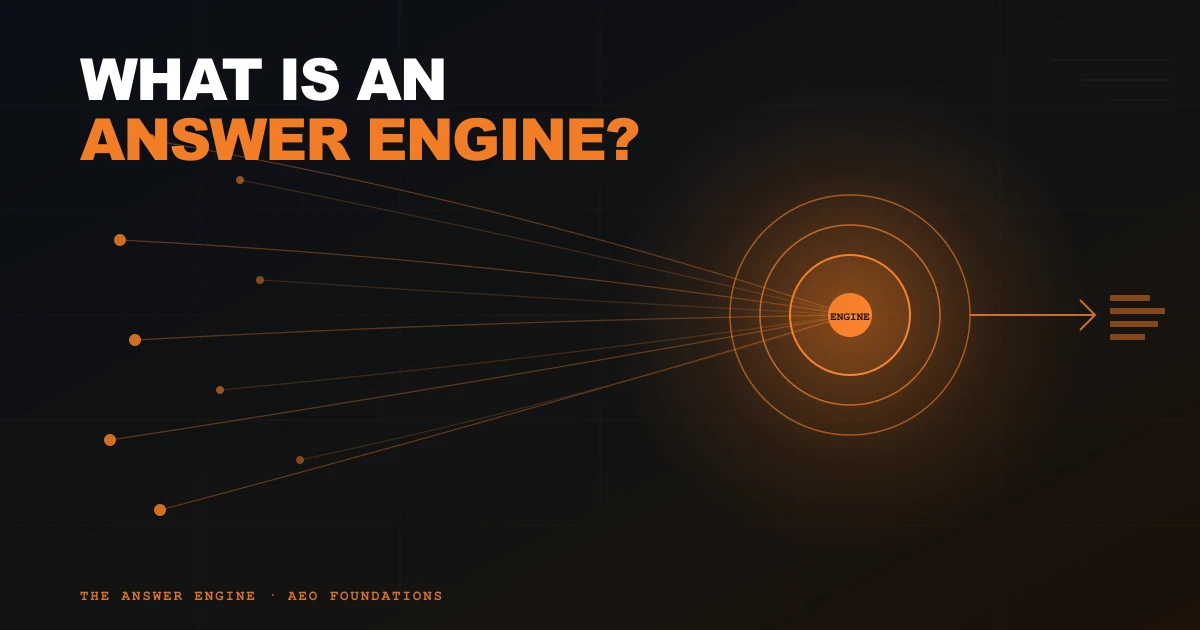
An answer engine is a generative AI system that responds to a user query with a synthesized written answer and inline citations to the sources it drew from. The product accepts a question in natural language, runs a live retrieval layer against an index of web content (or a partner index), scores the retrieved passages for authority and extractability, and writes a single response that weaves the top passages together with attribution links. The user reads one answer, not ten blue links. ChatGPT, Perplexity, Claude, Gemini, and Google AI Overviews are answer engines by this definition. A generative chatbot without retrieval and citations is not. To see whether your site is structured for the citation surface, run the free AEO Blindspot Scan.
Answer engines vs classic search engines
A classic search engine ends its job at the ranked-list stage. Google search returns ten links; the user opens them, reads them, and assembles an answer in their own head. An answer engine moves the assembly step inside the product. The retrieval and scoring layers of an answer engine still exist — they are the same kinds of layers a search engine runs — but a synthesis layer is added on top, and the synthesis layer is the surface the user actually reads. The business impact is that source visibility now requires being cited inside the synthesized answer, not just ranked on a results page. Questions on how this affects your funnel? Email support@theanswerengine.ai.
Why "engine" is the precise word
The word "engine" signals that the system is mechanical and measurable, not a magical AI black box. An answer engine runs a defined pipeline — retrieval, scoring, citation — and each stage of that pipeline rewards specific input signals on the source pages it pulls from. The pipeline is observable: a business can submit the same query to the same answer engine on three different days and watch which sources move in and out of the citation slot. That observability is what makes Answer Engine Optimization (AEO) a discipline rather than guesswork. The structural levers exist, the academic literature has measured them, and the impact on citation share is reproducible. Book a free 30-minute strategy session to walk through the pipeline for your vertical.
MechanismThe Mechanism: How an Answer Engine Produces an Answer
The retrieval-scoring-citation pipeline
Every major answer engine runs the same three-stage pipeline. Stage one is retrieval: the engine pulls candidate passages from its index based on semantic match to the query. Stage two is scoring: each candidate passage is weighted against authority, freshness, structural extractability, and entity signals. Stage three is citation: passages that clear the scoring threshold are quoted or paraphrased into the response with inline source attribution. A page that fails the retrieval stage never reaches scoring. A page that fails the scoring stage never reaches citation. Each stage filters the candidate pool further, which is why most pages on the open web are never cited by any answer engine. Reach our team at (213) 444-2229 for a guided walkthrough of where your pages typically fall out of this pipeline.
What earns a citation slot
The scoring stage weights structural extractability above content depth. Aggarwal et al. (KDD 2024) measured a 37% citation lift from added inline quotations and a 22% lift from added statistics across three answer engines. Zhang et al. (2026) measured a 57% influence premium on content opening with a clear plain-language definition. The Definition Premium: content that opens with a plain-language definition of its subject earns 57% higher citation probability in answer engines than content that buries the definition mid-article (Zhang et al., 2026). The mechanism is mechanical — answer-engine scoring layers weight the first sentence of every passage heaviest, and a definition-first opening collides cleanly with both relevance and authority signals. Synonym variants of the key terms boost retrieval diversity in parallel. Get your free AI readiness report to find your structural gaps now.
How answer engines weight authority
Authority in an answer engine is not domain authority in the SEO sense. Chen et al. (2025) documented a systematic bias in answer-engine models toward earned-media coverage and named-expert content, with a 1.9x citation lift on pages with a named author over anonymous brand pages. The Authority Graph Effect: answer engines cross-reference entity graphs (Person, Organization, sameAs links) before clearing the citation threshold, which is why pages with named authors and verifiable sameAs chains cite at 1.9x the rate of equivalent anonymous-brand pages (Chen et al., 2025). The practical translation is that a page needs a named author wrapped in Person schema, with sameAs links pointing to LinkedIn, professional licensure records, or industry associations, before the scoring stage rates it as a citation-worthy source. Lock in your exclusive market territory now — one client per market.
LandscapeThe Five Major Answer Engines in 2026
The answer-engine landscape consolidated in 2025 around five products that together capture the bulk of citation-generating queries. Each runs a distinct retrieval and scoring pipeline, but the structural signals that earn citations carry across all five. We publish a full engine-by-engine citation behavior report — email support@theanswerengine.ai for a copy.
ChatGPT and ChatGPT search
ChatGPT is the largest answer engine by monthly user volume. ChatGPT search, the live-retrieval mode launched in late 2024, routes queries through Bing's index, applies its own scoring layer on top, and returns a written response with numbered inline citations. ChatGPT scoring weights structured schema (Article, FAQPage, ProfessionalService), bounded passages, and named-author signals heavily. A page that is ranked outside the top ten on Bing can still be cited by ChatGPT search if its structural signals score high in the secondary layer. The reverse is also true: a top-ranked page can be skipped over if it presents as one long unbroken block. Call (213) 444-2229 to see how your pages score against ChatGPT's citation pipeline.
Perplexity
Perplexity is the answer engine built citation-first from launch. The product runs its own crawl and index, pairs it with a live web fetch, and returns every answer with three to seven numbered sources by default. Perplexity weights freshness and source diversity heavier than ChatGPT, which means a recently updated page with a clear publication date can outcite an older page from a higher-authority domain on the same query. Perplexity also surfaces a follow-up question pane that re-runs the pipeline on a related query, which compounds citation share for sites that cluster topically. Book a free strategy session to map your topic cluster against Perplexity citation patterns.
Claude, Gemini, and Google AI Overviews
Claude pairs its conversational interface with a web-search mode that pulls live passages from licensed and open web sources, returning answers with inline citations. Gemini is the answer engine inside Google's consumer product surface; it reads the Google index directly, which means it inherits Google's freshness pipeline but applies its own answer-engine scoring layer on top. Google AI Overviews is the answer-engine block that now appears above the ranked-link results on a growing share of Google search pages. AI Overviews scoring favors entity-rich content, schema completeness, and named-author signals — the same structural levers that score high across ChatGPT, Perplexity, and Claude. A site engineered for one major answer engine typically clears the citation bar on all five. Run a free AI Overviews readiness check against your site.
DistinctionsAnswer Engines vs Search Engines vs Chatbots
Search engines list — answer engines synthesize
A search engine's output is a ranked list of links. The user does the synthesis. An answer engine's output is a synthesized written answer with inline citations. The product does the synthesis. The same retrieval and scoring stages run under both, but the product surface differs: classic Google returns ten blue links; Google AI Overviews returns a paragraph with two to five named source attributions. The win condition flips accordingly. A business that needed a top-three ranked link on classic search now needs a named source mention inside the synthesized answer. The structural requirements for those two outcomes are different, which is why a strong SEO profile does not automatically translate to a strong answer-engine citation profile. Reach our team at (213) 444-2229 to map the gap between your current SEO baseline and your answer-engine baseline.
Chatbots converse — answer engines cite
A chatbot is a conversational generative interface, often built on a fixed knowledge cutoff with no live retrieval layer. Early ChatGPT was a chatbot in that sense — it produced fluent answers from training data without citing sources. An answer engine pairs the conversational interface with an active retrieval and citation pipeline. The presence of inline citations is the bright-line classifier. The Citation Bright Line: a generative product that returns synthesized text without inline source attributions is a chatbot, and a generative product that returns synthesized text with inline source attributions is an answer engine — the difference is mechanical, not branding (TAE classification, 2026). For a business, only the answer-engine mode produces a visibility surface to optimize for. Claim your exclusive market territory now before a competitor optimizes for the citation surface in your vertical.
Why the distinction matters for business
The distinction matters because it tells a business which surfaces are actually optimizable for inbound demand. A search engine surface is optimizable through traditional SEO. An answer-engine surface is optimizable through AEO. A pure chatbot surface, with no retrieval layer and no citations, is not optimizable at all — the model generates from training data and the only path to influence is being part of the next training run, which is a discipline closer to brand building than search optimization. Most generative products on the market in 2026 fall cleanly into one of these three categories, and the operator who classifies them correctly avoids burning budget optimizing for the wrong surface. Run the free AEO Blindspot Scan to see where your site stands on the answer-engine surface specifically.
| Product Type | Output Format | Has Inline Citations | Optimization Discipline |
|---|---|---|---|
| Search engine (classic Google) | Ranked list of links | No (links are the output) | SEO |
| Answer engine (ChatGPT, Perplexity, Claude, Gemini, AI Overviews) | Synthesized written answer | Yes (inline source attributions) | AEO |
| Chatbot (training-data-only generative product) | Synthesized written answer | No (no live retrieval) | None directly; brand-building over training cycles |
Why Answer Engines Matter for Businesses Now
The new buyer-journey surface
Answer engines are now a primary buyer-journey surface for both informational queries ("what is X", "how does Y work") and commercial-evaluation queries ("best provider for X", "who is the right Y for me"). A prospect asks ChatGPT or Perplexity the question, reads the synthesized answer, and decides which business to contact based on which names appear inline in the response. If the prospect's business need maps to a query the answer engine handles — and in 2026 most service-business needs do — then a business that is not cited inline is invisible at the stage where the buyer is forming a shortlist. Email support@theanswerengine.ai for the buyer-journey query map specific to your vertical.
The compounding citation advantage
Answer-engine citations compound differently than paid traffic. A paid ad stops the moment the budget stops. A citation earned inside an answer engine continues to surface every time a relevant query is asked, until the source is structurally outclassed. The Compounding Citation Curve: a page that earns its first answer-engine citations on a topic enters a recency-weighted authority loop that biases the engines toward citing the same source on subsequent related queries, which is why the first three to five domains cited in a vertical retain disproportionate citation share through the next scoring cycle (TAE measurement, 2025-2026). The implication is competitive: every quarter a business waits to enter the answer-engine surface, a competitor consolidates the authority loop that biases future citations toward their domain. Call (213) 444-2229 to see the current citation share landscape in your vertical.
What businesses do when they understand answer engines
A business that understands answer engines reorganizes its content production around the citation surface. Pages are restructured into bounded 80-to-180 word chunks with definition-first openings. Schema is added to every page that hosts a citation-worthy passage. A named author with a verifiable sameAs entity graph replaces anonymous brand bylines. A monthly Proof Ledger of 20 fixed queries across the four major answer engines replaces vanity ranking reports as the measurement instrument. The result is a content stack engineered for both Google's ranking layer and the answer-engine citation layer in the same draft — the dual-surface Origin Protocol we run on our own site and for every client we work with. Book a free 30-minute strategy call to walk through the Origin Protocol on your vertical.
An answer engine is a measurable system. The five major answer engines all reward the same structural signals on source pages. A business that optimizes for those signals enters the citation surface and compounds. A business that ignores them stays in the classic-search era while the buyer journey moves on. Run your free AEO Blindspot Scan to measure where you stand on the answer-engine surface today.
Answer Engine: Operator Cheat Sheet
| If You Want To... | The First Move Is... | Expected Timeline |
|---|---|---|
| Classify whether a product is an answer engine | Check for live retrieval + inline citations | 5 minutes per product |
| See your current citation surface gaps | Run the free AEO Blindspot Scan | 5 minutes, no login |
| Get cited by ChatGPT and Perplexity first | Restructure top pages into 80-180 word chunks with FAQ schema | 30 days to first citation |
| Earn the named-author 1.9x citation lift | Wrap every page in Person schema with sameAs links | 15-30 days to indexing |
| Compound citation share across all 5 engines | Establish a weekly publication cadence with named author | 60-90 days to compounding effect |
| Lock out competitors in your market | Claim your exclusive territory before they do | Window closes as markets saturate |

Run Your Free AEO Blindspot Scan — See Exactly Which Answer Engines Cite You
The AEO Blindspot Scan checks your site against 47 citation signals across all five major answer engines and returns your exact score — free, no login required, ready in five minutes. The next quarter of citation share belongs to whoever fixes the structural gaps first.
Run Free AEO Blindspot Scan →Frequently Asked Questions
What is an answer engine in plain English?
An answer engine is a generative AI system that responds to a user query with a synthesized written answer and inline citations to the sources it drew from. The deliverable is a complete answer plus the named sources that support it, not a ranked list of links. ChatGPT, Perplexity, Claude, Gemini, and Google AI Overviews are the major answer engines as of 2026. The structural pattern is the same across all of them: retrieve relevant passages, score them for authority and extractability, then weave the top passages into a written reply with attributions.
How is an answer engine different from a search engine?
A search engine returns a ranked list of links and ends its job there — the user clicks, reads, and synthesizes the answer themselves. An answer engine does the synthesis step inside the product, returning a written response with inline citations. Google search is a search engine. Google AI Overviews and Gemini are answer engines. ChatGPT, Perplexity, and Claude are answer engines that have no traditional ranked-link surface at all. The win condition flips from a click on a blue link to a named source mention inside a generated answer.
How is an answer engine different from a chatbot?
A chatbot is a conversational interface, often without a live retrieval layer. An answer engine pairs the conversational interface with an active retrieval and citation pipeline — it pulls fresh passages from an index, weights them, and shows the user where the information came from. Early ChatGPT was a chatbot. ChatGPT with web search is an answer engine. The difference matters for businesses because only the citation-enabled mode produces source attributions, which is the surface a business needs to appear on.
Which products count as answer engines in 2026?
The five answer engines that drive material citation traffic as of mid-2026 are ChatGPT (with search), Perplexity, Claude (with web search), Google Gemini, and Google AI Overviews. Bing Copilot, You.com, and Brave AI sit a tier below in traffic share but use the same answer-engine pattern. Each runs a slightly different retrieval and scoring pipeline, but the citation threshold rewards the same structural signals: bounded passages, definition-first openings, schema presence, named-author attribution, and a verifiable entity graph.
Why does the rise of answer engines matter for my business?
Answer engines are now a primary buyer-journey surface for informational and commercial queries. A prospective customer asks ChatGPT or Perplexity a question, reads the synthesized answer, and decides who to call based on which businesses were named in the response. A business that ranks first on Google but never appears in the answer-engine response loses that customer at the synthesis stage, before the ranking stage even gets evaluated. Answer Engine Optimization (AEO) is the discipline of structuring a site so the answer engines cite it.
Is an answer engine the same thing as Answer Engine Optimization (AEO)?
No. An answer engine is the system — ChatGPT, Perplexity, Claude, Gemini, AI Overviews. Answer Engine Optimization (AEO) is the practice of structuring a website so those systems cite it. The two terms travel together because AEO would not exist without answer engines, but they are distinct: an answer engine is a product category, and AEO is the optimization discipline aimed at that product category. Questions on AEO setup? Email support@theanswerengine.ai.
Related AEO Concepts
- Answer Engine Optimization: The Complete Guide
- AEO vs SEO: What Is the Difference?
- Anatomy of an AI Citation
- AEO Models: How AI Search Picks Sources
- What Is AEO for Small Businesses?
- AEO Grader: How to Score Your AI Search Visibility