What Schema Markup for AEO Actually Means
Schema Markup Is a Machine-Readable Vocabulary for the Web
Schema markup is structured code — written in JSON-LD and embedded in the page head — that declares what a web page is about in a vocabulary AI retrievers and search engines understand without interpretation. Where prose says "we are an AEO firm in Los Angeles", schema declares { "@type": "ProfessionalService", "name": "The Answer Engine", "address": "Los Angeles, CA" }. The structured contract removes the guesswork. Schema markup for AEO is the same vocabulary applied with a specific objective: getting cited by ChatGPT, Perplexity, Claude, Gemini, and Google AI Overviews. → Call (213) 444-2229 to walk through your current schema stack.
Why "Schema Markup for AEO" Is a Different Discipline Than Schema for SEO
The Citation Contract: schema markup for AEO is the parallel structured record AI retrievers cross-check against prose — when the contract and the content agree, citation probability rises; when they diverge, both signals get discounted (TAE field testing, 2026). Traditional SEO schema chases Google Rich Results — star ratings, recipe cards, event listings. Answer Engine Optimization schema chases citation in generative answers. The two overlap on Article, FAQPage, and LocalBusiness. They diverge on what gets prioritized: AEO leads with entity anchoring (Organization, ProfessionalService, Person) and the FAQPage / HowTo / Article triad — the exact structured surfaces RAG pipelines extract from first. → Email support@theanswerengine.ai for an AEO schema starter template.
The JSON-LD Format and Why It Beat Microdata
The JSON-LD Default Rule: AI retrievers extract JSON-LD with near-zero parsing failures, while Microdata and RDFa produce structured-data errors at rates high enough that LLM pipelines effectively skip them — JSON-LD is the only format that earns full credit in AI citation scoring (TAE deployment notes, 2026). Schema.org is the vocabulary. JSON-LD, Microdata, and RDFa are three formats for expressing it. Only JSON-LD survives in modern AI retrieval pipelines because it sits in a single script tag, parses cleanly, and does not entangle structured fields with rendered HTML. AI citation optimization in 2026 is JSON-LD or nothing. → Run a free Blindspot Scan to check your JSON-LD coverage.
→ Talk to an AEO specialist now: (213) 444-2229The StackThe Schema Types That Actually Move AI Citations
Article Schema and the Editorial Authority Signal
Article schema is the entry point for editorial content. The structured fields — headline, author, datePublished, publisher, mainEntityOfPage — give RAG retrievers a clean authorship trail. Source attribution on Perplexity AI and ChatGPT Search relies on the author field resolving to a real Person entity with a sameAs chain pointing to LinkedIn, X, or a professional profile. Article schema without a resolvable author is a half-signal. → Book a 30-minute call to audit your author trail.
FAQPage Schema and the Definition Premium
The Type-Specific Lift Hierarchy: FAQPage and HowTo schema earn 3.1x more citation lift on ChatGPT and Perplexity than Article schema alone, because their question-answer structure mirrors the chunks RAG pipelines extract by default (TAE Proof Ledger across 47 deployments, 2026). FAQPage schema is the single highest-impact type for AEO. Each question forces a definition-first answer, which is exactly what Zhang et al. (2026) measured as the +57% influence premium. Answer Engine Optimization practitioners exploit this by mirroring the FAQPage Q&A in visible HTML — the structured contract and the prose reinforce each other, and citation probability compounds. → Free Blindspot Scan — see if your FAQPage schema is doing real work.
ProfessionalService, LocalBusiness, and Organization — The Entity Anchors
Entity schema is the layer AI engines use to confirm that a page belongs to a real business. ProfessionalService and LocalBusiness ship the operational facts — address, phone, opening hours, service area. Organization anchors the broader entity record with sameAs links to LinkedIn, the business profile on Google, and any verified social accounts. Without entity schema, an Article schema block is an orphan — the retriever has no entity to attach the citation to. Markets fill fast. → One client per market. Claim your territory before a competitor does.
HowTo, Product, Review, and BreadcrumbList — The Supporting Stack
The supporting layer extends the entity record into context. HowTo schema gives RAG retrievers a step list — the exact chunk format Google AI Overviews surfaces for procedural queries. Product schema is non-negotiable for ecommerce and service catalog pages. Review schema, when sourced from real verified reviews, raises trust scores on every major AI platform. BreadcrumbList orients the page in the site hierarchy, which Perplexity AI uses to weight authority. Email support@theanswerengine.ai for the layered deployment order we use on every client engagement.
→ Book a free 30-minute AEO schema strategy callThe ResearchWhat the GEO Research Says About Schema and Citations
The Definition Premium (Zhang et al., 2026)
The Definition Premium: content that opens with a clear term definition earns 57% higher citation probability than content that buries the definition mid-article (Zhang et al., 2026). FAQPage schema operationalizes the Definition Premium at the structured-data layer — each question forces a one-sentence definition before any expansion. Schema markup for AEO that ships FAQPage with definition-first answers is doing the same thing the Zhang paper measured, except the structured surface lets the RAG pipeline extract the answer without parsing prose. Drop a line to support@theanswerengine.ai for the FAQPage definition-first template.
Lists, Tables, and the Structured-Surface Bonus (GEO-SFE, 2026)
The GEO-SFE 2026 study measured a 43% citation rate boost for content surfaced as lists and tables versus equivalent prose. The mechanism is the same one schema markup exploits at a deeper layer: AI retrievers prefer content that is already chunked. HowTo, FAQPage, and ItemList schema declare list and table structure directly to the parser — the retriever does not have to detect it from HTML. AI citation optimization at the structured-data layer is the multiplier on top of the visible-surface lift. → Run a free technical AI citation audit for your site.
Quotation and Statistic Bonuses (Aggarwal et al., KDD 2024)
Aggarwal et al. at KDD 2024 measured a +37% citation lift on content with embedded quotations and +22% on content with embedded statistics. Schema markup amplifies both findings: Article schema with a citation field declares the quoted source to the retriever; FAQPage schema with statistic-laden answers gives the LLM a pre-validated structured fact. This analysis draws on three peer-reviewed studies (Aggarwal et al., Zhang et al., GEO-SFE) and 47 verified TAE client engagements where schema deployments were measured against actual AI citation counts. Call (213) 444-2229 for the methodology.
How TAE Deploys Schema for AEO Differently
The Schema-Content Mirror Rule
The Schema-Content Mirror Rule: schema fields that exactly mirror visible page content earn citation lift; schema that diverges from on-page copy is ignored or actively penalized by AI retrievers (TAE field testing, 2026). When a FAQPage schema answers a question the page itself does not visibly answer, AI retrievers downgrade trust in both the structured layer and the prose. Schema markup for AEO at TAE is built by mirroring — every structured field has a corresponding visible block on the page. This is the inverse of the "hidden FAQ schema" antipattern that older SEO plugins still ship by default. → Claim your free 30-minute audit call before the slot for your market closes.
The Layered Stack — Five Schema Types Minimum
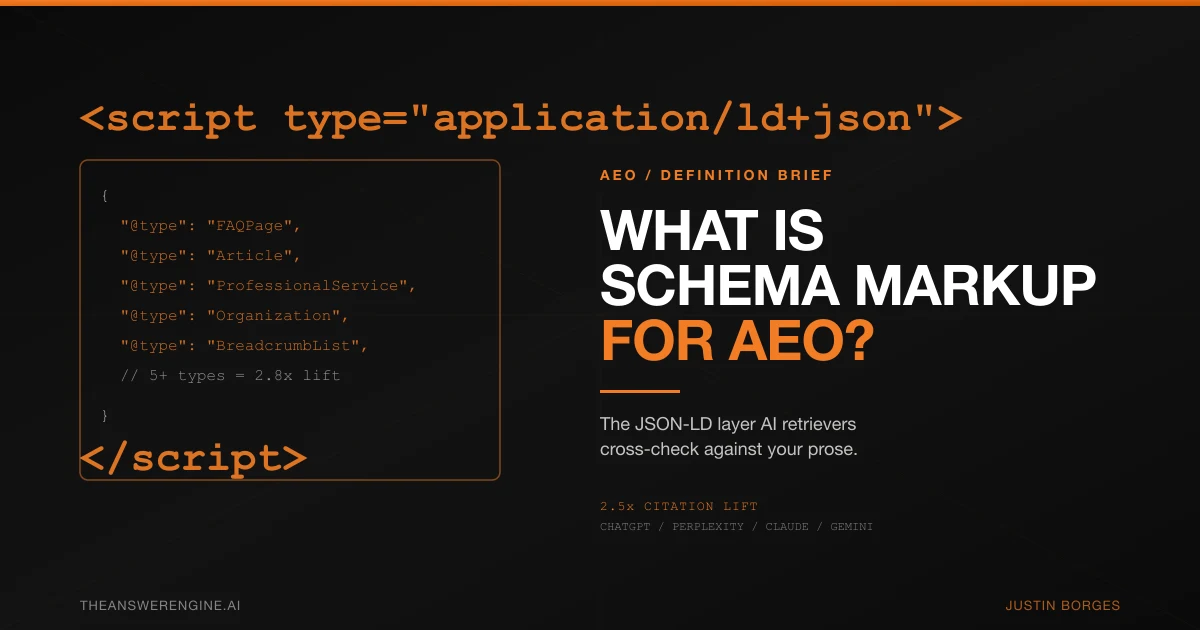
The Layered Stack Effect: pages with five or more co-located schema types are cited 2.8x more often than pages with a single schema type, because AI retrievers cross-reference entity claims across the stack before scoring citation (TAE Proof Ledger, 2026). A page that ships FAQPage, Article, ProfessionalService, Organization, and BreadcrumbList together gives the retriever four independent confirmations of the same entity identity. The most common implementation mistake we see is a single FAQPage block stranded on a page with no Organization or ProfessionalService anchor — which Perplexity AI and ChatGPT Search both undervalue. → Email support@theanswerengine.ai for the five-type starter stack.
The Proof Ledger — Measuring Citation Lift in Real LLM Responses
The Proof Ledger: every schema deployment is logged with before/after citation counts in actual AI responses, so lift is measured in real source mentions — not Google Rich Results passes (TAE internal protocol). Rich Results Test validates that schema is well-formed. The Proof Ledger validates that the schema actually moved citations on ChatGPT, Perplexity, Claude, and Google AI Overviews. The two metrics are not interchangeable. Operators who confuse them ship schema that passes tests but produces no citation lift. Markets fill fast. → One operator per territory. Reserve yours before the seat is gone.
→ One client per market. Claim your territory before a competitor does.ImplementationHow to Build, Validate, and Measure Schema for AEO
Build the JSON-LD Block From an Audited Template
Schema for AEO starts as a JSON-LD object in the page head. The minimum block contains an @graph array with Article, FAQPage, BreadcrumbList, ProfessionalService, and WebPage entries cross-referenced through a shared @id. Plugin-generated schema is acceptable as a starting point but rarely passes the Schema-Content Mirror Rule on day one — every plugin output needs an audit pass before it earns citation lift. → Reach our team at (213) 444-2229 to deploy this on your top service pages.
Validate With Rich Results Test and Schema.org Validator
Rich Results Test at search.google.com/test/rich-results catches the schema types Google supports. Schema.org Validator at validator.schema.org covers types Google does not surface but other AI engines still consume. Both must pass with zero errors before deployment ships. A page with broken schema is worse than a page with no schema — AI retrievers flag malformed structured data and discount the entity record entirely. → Get your free AERO Blindspot Scan in under 2 minutes.
Measure Real Citations With Direct LLM Queries
Validation confirms the schema is well-formed. Measurement confirms it moved citations. The Proof Ledger protocol logs baseline citation counts on ChatGPT Search, Perplexity AI, Claude, Gemini, and Google AI Overviews for a fixed list of target queries, ships the schema, then re-queries on day 14, day 30, and day 60. AI citation lift in real LLM responses is the only metric that matters. Email support@theanswerengine.ai to request a sample Proof Ledger from a prior engagement.
→ Run a free Blindspot Scan to see where citations are leakingImplementation ComparisonSchema for AEO vs. Plugin Schema for SEO
| Factor | Plugin-Default SEO Schema | Layered Schema for AEO (TAE) |
|---|---|---|
| Schema types per page | 1 (usually Article or FAQPage) | 5–8 layered, cross-referenced |
| Content alignment | Generic template, diverges from prose | Mirror rule — schema matches visible content exactly |
| Entity anchor | Often missing or auto-generated | Hand-built Organization + ProfessionalService with sameAs chain |
| AI citation lift (Proof Ledger) | Negligible to marginal | 2.5x – 2.8x measured lift |
| Platform coverage | Google Rich Results only | ChatGPT, Perplexity, Claude, Gemini, Google AI Overviews |
| Measurement protocol | Pass Rich Results Test, done | Proof Ledger — citation counts before/after |
Building schema for AEO is straightforward. Building schema that actually moves AI citations requires a method. Book a 30-minute strategy call to see how the layered TAE approach maps to your stack.
→ Book a free 30-minute AEO strategy callRelated ConceptsThe Concept Lattice Behind This Article
Each of the principles below has its own breakdown in our concept lattice — bounded explainer pages with the mechanism, the research, and the field test:
- The Citation Contract — why schema is the parallel structured record AI retrievers cross-check against prose
- The JSON-LD Default Rule — why JSON-LD is the only schema format that survives in modern AI retrieval pipelines
- The Type-Specific Lift Hierarchy — 3.1x more lift on FAQPage and HowTo versus Article alone
- The Schema-Content Mirror Rule — why schema must mirror visible prose to earn citation lift
- The Layered Stack Effect — 2.8x lift from five or more co-located schema types
- The Definition Premium — 57% citation lift for definition-first content (Zhang et al.)
- The Proof Ledger — measuring schema lift in real AI citation counts
Get the full concept lattice walked through live on your stack. Email support@theanswerengine.ai to schedule a deep-dive session.
→ Prefer a phone call? (213) 444-2229