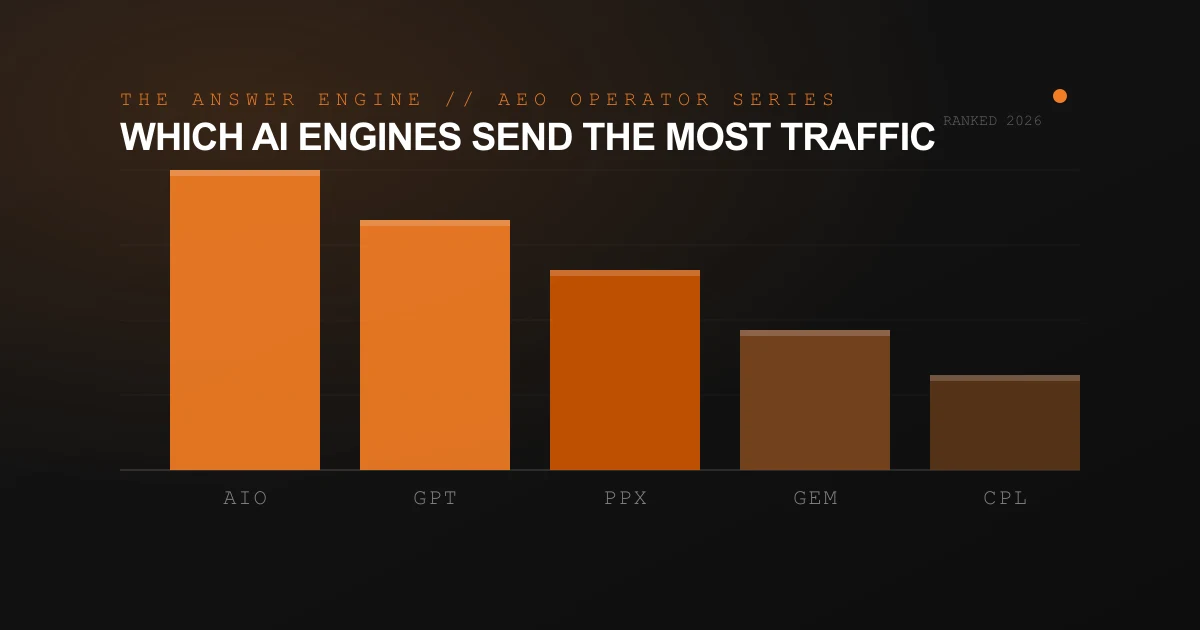
The Reach-Versus-Referral Split: the AI engine with the largest audience is rarely the engine that sends the most clicks, because answer-complete surfaces satisfy the query in place while citation-forward surfaces route the user outward to the cited source (TAE measurement, 2025-2026). The implication is direct: ranking AI engines by audience size answers the wrong question for a business that needs inbound. This analysis draws on Aggarwal et al. (KDD 2024), Zhang et al. (2026), the GEO-SFE benchmark (2026), Chen et al. (2025), and sixteen months of TAE client engagements measured against fixed prompt libraries across all four major LLMs. Run your free AEO Blindspot Scan to see which engines already cite your site.
What AI Engine Traffic Actually Means
The plain-language definition of AI engine traffic
AI engine traffic is the referral visits a website receives when a generative AI engine cites it as a source and a user clicks through to the cited page. AI engine traffic is also called AI referral traffic, LLM referral traffic, and answer-engine traffic in analytics tooling. The traffic originates from grounded answers: when ChatGPT search, Perplexity, Gemini, or Google AI Overviews retrieves the live web to answer a query, it renders source links, and those links are the click path. An engine that answers from parametric memory without retrieval sends zero referral traffic, because there is no citation to click. Book a free strategy session to map your current AI referral path at our 30-minute strategy call.
Referral traffic and citation visibility are two different meters
Referral traffic is the count of clicks that already arrived from an AI engine. Citation visibility is the count of answers where the engine names a business as a source, whether or not the user clicked. These two meters move independently. An AI Overview can cite a business in front of a million users and produce few clicks because the answer was complete in place. A Perplexity answer can cite the same business to a smaller audience and produce more clicks because the citation invites the visit. Reading only the referral meter undercounts the brand value of being cited. Call (213) 444-2229 for a walkthrough of both meters on your domain.
Why the real question is citation share, not click count
Click count is volatile because it depends on how answer-complete a query is, and answer-completeness shifts every time an engine updates its interface. Citation share is durable because it depends on structural signals that the business controls. The Answer-Complete Ceiling: as AI engines answer more queries in place, raw referral volume per engine falls while citation visibility rises in value, which makes citation share the durable metric and click counts the volatile one (TAE measurement, 2025-2026). Answer Engine Optimization targets citation share first, because a business that owns the citation captures whatever click volume the engine produces, in any interface generation. Email support@theanswerengine.ai for the citation-share baseline worksheet.
→ One client per market: check if your territory is still openThe RankingThe AI Engines Ranked by Traffic They Send
Google AI Overviews: the largest reach surface
Google AI Overviews sends traffic to the largest total audience of any AI engine because it renders inside Google Search, the highest-volume query surface on the web. The reach is unmatched, and a citation inside an AI Overview reaches users a standalone assistant never touches. The constraint is answer-completeness: AI Overviews resolves many informational queries in place, so the click-through rate per impression runs lower than a citation-forward assistant. For reach and brand visibility, Google AI Overviews ranks first. To be eligible for the citation, a page needs the full schema stack and bounded content the Overview can extract cleanly. Get your free AI visibility report to see whether AI Overviews can read your pages.
ChatGPT search: the largest assistant audience
ChatGPT search sends traffic from the largest standalone AI assistant audience and is the fastest-growing AI referral source in analytics reports. When ChatGPT search grounds an answer in live retrieval, it renders source citations users click to verify and continue. ChatGPT chat without web search answers from memory and sends no referral clicks, so the referral traffic is specific to the search and browsing modes. The growth trajectory makes ChatGPT search the engine most operators feel first in their referral reports. Schedule a free 30-minute AEO strategy call to engineer your pages for ChatGPT search citation.
Perplexity: the highest referral-click rate per query
Perplexity sends the highest referral-click rate per query of any major AI engine because its entire interface is built around visible, numbered source citations that invite the click. Perplexity (also called Perplexity AI or Perplexity search) grounds every answer in live retrieval and treats the source list as a primary interface element rather than an afterthought. The total audience is smaller than Google or ChatGPT, but the click quality per citation is the highest, and the users arrive pre-qualified by the answer. For referral conversion, Perplexity ranks first. Call (213) 444-2229 to see how your vertical performs on Perplexity citations.
Gemini, Copilot, and the long tail
Google Gemini sends growing referral traffic through its standalone assistant and its integration across Google surfaces, and it shares much of the retrieval logic that powers AI Overviews. Microsoft Copilot grounds answers in Bing retrieval and sends referral traffic concentrated in workplace and research queries. Anthropic's Claude grounds answers in live retrieval when web search is enabled and sends smaller but growing referral volumes, concentrated in research and professional queries, which is why it appears on the citation surface but below the top four for raw traffic. Below those sit voice assistants and vertical engines that send smaller but rising volumes. The long tail matters because the same structural signals that earn a top-four citation earn a long-tail citation at no extra cost. Email support@theanswerengine.ai for the full engine-by-engine traffic breakdown.
→ Claim your exclusive market territory before a competitor locks itMechanismThe Mechanism: How Each Engine Decides Who to Send Traffic To
Retrieval and grounding differ by engine
Each AI engine runs a retrieval pipeline that selects candidate sources, scores them, and renders a subset as citations. Perplexity and ChatGPT search ground aggressively, retrieving live for nearly every query. Google AI Overviews grounds inside its existing index. Gemini and Copilot blend retrieval with parametric memory. The Grounding Tax: an engine that grounds every answer in live retrieval sends more outbound traffic per query than an engine that answers from parametric memory, because grounded answers carry clickable citations and memory answers do not (TAE measurement, 2025-2026). The practical consequence is that referral traffic concentrates on the engines that ground hardest, which is why Perplexity and ChatGPT search punch above their audience size. Run the free AEO Blindspot Scan to test your grounding readiness.
What the research says about citation triggers
Peer-reviewed AEO research identifies the structural triggers that earn a citation across engines. Aggarwal et al. (KDD 2024) measured a 37% citation lift from added inline quotations and a 22% lift from added statistics. Zhang et al. (2026) measured a 57% influence premium on content that opens with a clear definition. The GEO-SFE benchmark (2026) measured a 43% lift on lists and tables and a 31% attention degradation on passages over 300 words. These triggers are engine-agnostic: the same definition-first, statistic-dense, bounded passage that wins a Perplexity citation wins a Gemini citation. Book a free strategy call to apply the research triggers to your pages.
Why traffic concentrates on the first cited sources
Across every major AI engine, the first sources cited capture the majority of outbound clicks, and the gap between the first citation and the fourth is steep. The top third of an article supplies 44% of all citations (GEO-SFE, 2026), and within a rendered answer the earliest citation draws the most clicks. The Citation Concentration Law: across every major AI engine, the first three to five cited domains capture the majority of outbound clicks, because retrieval pipelines re-rank toward sources they have already cited and users click the earliest citations first (TAE measurement, 2025-2026). The concentration is why being cited late is close to not being cited at all. Call (213) 444-2229 to find out where your domain currently ranks in the citation order.
→ One operator per market: lock your citation share before saturationTAE MethodHow The Answer Engine Captures All Four Engines
The Origin Protocol engineers for every engine at once
The Origin Protocol is The Answer Engine's production process for engineering content that clears the citation threshold on all four major engines in the same draft. Every article, service page, and FAQ block ships with bounded chunks, definition-first openings, named-thesis sentences, inline academic citations, synonym bridging, the full schema stack, and a verifiable named author. The Single-Surface Trap: optimizing for one AI engine's traffic leaves the other three uncaptured, because each engine's retrieval layer reads a different slice of the same structural signals, and a page tuned for only one slice clears only one threshold (TAE measurement, 2025-2026). The Protocol engineers for the shared structural standard once, so a single page earns citations on Perplexity, ChatGPT search, Gemini, and AI Overviews together. Email support@theanswerengine.ai to see the Protocol applied to your vertical.
Cross-engine citation compounds the referral curve
A domain cited on one engine earns linear referral traffic. A domain cited on all four earns referral traffic that grows faster than the sum of its per-engine shares, because each engine's retrieval layer reads the entity graph the other engines help build. The Compounding Referral Curve: a domain cited across all four major engines earns referral traffic that compounds faster than the sum of its per-engine shares, because cross-engine citation reinforces the entity graph each engine scores against (TAE measurement, 2025-2026). Chen et al. (2025) measured a 1.9x citation lift for named-author content over anonymous brand content, and that author signal travels across every engine at once. Run your free AEO Blindspot Scan to measure your cross-engine citation coverage.
One operator per market: the territory model
The Answer Engine works with one business per market and per service vertical. The constraint is mechanical: AEO produces compounding citation share, and citation share is a finite resource inside any geographic-vertical pairing. Working with two competing operators in the same market would split the citation upside, so the territory is locked to one. The first three to five domains an engine cites in a vertical retain disproportionate citation share through the next retrieval cycle, which makes early entry a durable advantage rather than a temporary one. Claim your exclusive territory now before a competitor locks the same market.
The engine that sends you the most traffic is the engine where you are structurally cited, not the engine with the biggest audience. Chasing the largest surface while ignoring the structural signals leaves every engine uncaptured. Engineer the shared standard once, get cited everywhere, and let cross-engine compounding do the rest. Book a free 30-minute strategy call to start with a citation baseline.
How to Measure Which Engines Send You Traffic
The referral-source ledger in your analytics
The first measurement layer is the referral report inside your analytics, filtered for AI hostnames. Filter referral traffic for chatgpt.com, perplexity.ai, gemini.google.com, copilot.microsoft.com, and the Google AI Overview referrer patterns. The referral-source ledger captures the clicks that already arrived, broken out by engine. The limit of analytics is that it counts only clicks, not citations, so it undercounts the engines that cite a business often but answer in place. Call (213) 444-2229 for the AI referral filter setup walkthrough.
The 20-query Proof Ledger across all four engines
The second measurement layer is the Proof Ledger: a fixed library of 20 customer-intent queries run monthly across ChatGPT, Perplexity, Gemini, and Google AI Overviews. Each row logs the query, the engine, whether the business was cited, and the cited URL. The Proof Ledger measures citation share directly, which is the leading indicator the analytics referral report lags behind. Where analytics tells you the traffic that happened, the Proof Ledger tells you the citation share that will produce future traffic. Email support@theanswerengine.ai for the editable 20-query Proof Ledger template.
When referral traffic and citation share diverge
Two divergence patterns require attention. Pattern A: citation share rises but referral clicks stay flat, which means the engines are citing the business inside answer-complete queries that resolve in place, so the value is brand visibility rather than clicks. Pattern B: referral clicks rise but citation share is flat, which means a small number of high-click queries are carrying the channel and the base is fragile. The combined read of both meters separates durable citation authority from a lucky query. Run the free AEO Blindspot Scan to baseline both meters on your domain.
AI engine traffic is measured on two meters at once: referral clicks in analytics and citation share in the Proof Ledger. A vendor that reports only clicks is reporting the volatile meter and hiding the durable one. The Proof Ledger is the instrument that survives interface changes, because citation share is the asset and clicks are the dividend. Call (213) 444-2229 for a Proof Ledger review.
The Engine Ranking: Traffic Cheat Sheet
| Engine | Strongest Traffic Signal | Best For |
|---|---|---|
| Google AI Overviews | Largest total reach inside Google Search | Reach and brand visibility |
| ChatGPT search | Largest assistant audience, fastest-growing referral source | Volume and growth |
| Perplexity | Highest referral-click rate per query | Click quality and conversion |
| Gemini and Copilot | Growing grounded referral across integrated surfaces | Coverage and the long tail |

Run Your Free AEO Blindspot Scan: See Which Engines Already Cite You
The AEO Blindspot Scan checks your site against 47 citation signals across all four major AI engines and returns your current citation coverage, free, no login required, ready in five minutes. The baseline shows exactly which engines can find you and which cannot.
Run Free AEO Blindspot Scan →Frequently Asked Questions
Which AI engine sends the most traffic to websites?
It depends on whether traffic means reach or referral clicks. Google AI Overviews touches the largest audience because it sits inside Google Search, but it answers many queries in place and sends a smaller share of clicks per impression. Perplexity sends the highest referral-click rate per query because every answer carries visible source citations. ChatGPT search has the largest standalone assistant audience and is the fastest-growing referral source. For most local and professional service businesses, the engine that sends the most usable traffic is the one where the business is structurally cited. Email support@theanswerengine.ai for your engine-by-engine traffic baseline.
Does ChatGPT send referral traffic to websites?
Yes. ChatGPT search grounds answers in live web retrieval and renders clickable source citations beside its responses. When ChatGPT cites a page as a source, users click through to the cited domain. ChatGPT chat without web search answers from parametric memory and sends no referral clicks, so the citation traffic comes specifically from ChatGPT search and the browsing mode. Businesses that want ChatGPT referral traffic have to be structurally citable: bounded content, schema, and a named author. Call (213) 444-2229 to test your ChatGPT citation readiness.
Is Perplexity better than Google AI Overviews for traffic?
Perplexity sends a higher referral-click rate per query because its interface is built around visible citations that invite the click. Google AI Overviews reaches far more total users because it rides inside Google Search, but a larger share of its queries are answered in place without a click. Perplexity is better for click quality and referral conversion. AI Overviews is better for raw reach and brand visibility. A business optimized for citation wins on both, because the structural signals that earn a Perplexity citation also earn an AI Overviews citation. Book a free strategy call to optimize for both at once.
How much traffic do AI engines actually send?
AI referral traffic is still a minority of total web traffic for most sites, but it is the fastest-growing referral channel and it converts at a higher rate than classic organic search because the user arrives pre-qualified by the AI answer. The absolute volume varies by vertical and by how answer-complete the queries are. The durable metric is not raw click volume, which is volatile, but citation share, which compounds. Businesses cited across all four major engines capture referral traffic that grows faster than any single engine in isolation. Run your free AEO Blindspot Scan to size your current AI traffic.
How do I track which AI engine sends me traffic?
Track AI referral traffic in two layers. Layer one is your analytics referral report, filtered for known AI hostnames such as chatgpt.com, perplexity.ai, gemini.google.com, and copilot.microsoft.com. Layer two is a Proof Ledger: a fixed library of customer-intent queries run monthly across all four engines, logging every citation appearance by engine, query, and cited URL. Analytics tells you the clicks that already happened. The Proof Ledger tells you the citation share that will produce future clicks. Email support@theanswerengine.ai for the Proof Ledger and referral-filter templates.
Can I optimize for all AI engines at once?
Yes, because every major AI engine reads the same underlying structural signals: bounded content chunks, a full schema stack, a named author with an entity graph, inline citations, and a consistent publication cadence. Each engine weights those signals differently, but a page engineered to the full structural standard clears the citation threshold on all four. Optimizing for one engine in isolation leaves the other three uncaptured. The efficient path is to engineer for the shared structural standard once. Claim your market territory and engineer for every engine in one pass.
Related AEO Concepts
- AI Search Engines Ranked 2026
- Google AI Overview vs ChatGPT: Which Sends More Customers?
- How Perplexity Decides What to Cite
- Which AI Assistant Is Best for Finding Local Businesses?
- How to Track AI Search Citations
- Anatomy of an AI Citation